
Kundalini Yoga Teacher, Vedic Astrologer, Scientist of Consciousness
Kundalini Yoga:
FAQ &
Practictioner’s Manual
This page functions as a reference and user manual for Kundalini Yoga, offering guidance for both new and established practitioners—from entry-level foundations to the more subtle dimensions of the practice.
Its purpose is to bring clarity and transparency to what Kundalini Yoga is, how it works, and how it is embodied.
The material spans definition, evolving methodology, practical guidelines, and insight into the internal processes and transformations that accompany sustained practice.
You may explore this page linearly or intuitively, according to your own inclination. Some will engage in detailed study, while others will allow understanding to emerge through direct experience.
If questions arise that are not addressed here, you are welcome to reach out to Chand via the contact page.
In the expandable accordion sections below, I will address some of the commonly asked questions about Kundalini Yoga
Kundalini Yoga is not a cult. It is a form of applied yoga science that has its roots in ancient yoga, and its iterative evolutionary stages through time.
In the past, there have been organizations which have established themselves in the teachings of Kundalini Yoga – and many other forms of Yoga & Meditation – that evolved to embody “cult-like” behaviors.
I, Chand Tagdeep, am not associated with any specific organization related to the teachings of Kundalini Yoga or Meditation. Rather, I am an independent teacher and have aligned myself with the Association of Spiritual Integrity and their agreements towards right action in teaching.
Kundalini Yoga is a way of yoga that nearly any person may participate in.
Yoga is an INCLUSIVE science and practice. Despite the Western Commercialism projections that market yoga products to skinny-fit models in tight spandex who perform incredible gymnastic-style poses, the practice of Yoga is and should be accessible to all.
In my teachings it is encouraged that anyone meet themselves where they are now. This means that all modifications to the practice are welcomed so that anyone of any stage of life may participate.
A student in a wheelchair may modify their practice to meet them in the wheelchair. Even a quadriplegic may practice using the scientific supported method of the proprioseptive imagination.
This means it is better to be supported by any props such as cushions, blocks, straps, etc., than to avoid them due to embarrassment.
As my teacher Guru Singh would say, “We do the best we can and be happy with it!”
This means we never should push ourselves beyond our limits. Forcing strain and risking injury is always counter-productive to the practice of Yoga which presents slow and steady results over time, by finding our edge and gently leaning into it.

Yoga is the ancient art and science of union—of yoking the river of individual awareness to the ocean of universal consciousness.
Rooted in the Sanskrit word yuj, meaning to join or to unify, yoga is a pathway of integration. It is an invitation into presence, a means of aligning the body, mind, and spirit with the pulse of truth.
More than a sequence of postures, yoga is a living technology of remembrance. It reconnects us to the inner radiance beyond thought and form.
Through pranayama, asana, mantra, and meditation, yoga becomes a complete vessel of direct experience—where the boundary between self and source softens, and the sacred reveals itself in all things.
This path is not one of arrival, but of resonance. It is a journey of attuning to wholeness, of remembering the divine not as something distant, but as the indwelling presence within and around us.
Yoga calls us to live in harmony with that presence—honoring life as ceremony, and the Self as sanctuary.
Step into the Aquarian Age, with its rapid shifts and demands for personal sovereignty, this yoga offers both a foundation and a launchpad.
If you’re seeking something profound, revolutionary, and deeply resonant — welcome home.
Kundalini, from the Sanskrit root kundala—“coil” or “spiral”—is the luminous thread of creative consciousness woven through the very fabric of our being. It is not a concept, but a living presence: coiled at the base of the spine like a sleeping serpent, listening for the song that will wake it.
In the innocence of birth, this radiant current moves with freedom—flowing naturally through the body as clarity, connection, and joy. Yet as we grow, the weight of conditioning, trauma, and expectation often clouds this light. What once streamed freely folds inward, becoming still, but never lost. It waits, not in punishment, but in patience.
Kundalini is the sacred intelligence of life, resting near the root chakra (Muladhara) and the energetic center known as the Dantien. It lives where the physical and subtle bodies meet—bridging nerve, breath, and spirit. Though associated with anatomy, it is not of the body alone. It is the quiet hum of infinity within form.
When we step onto the path of Kundalini Yoga, we do not awaken this force through domination or demand. We enter a relationship of reverence. Through breath (pranayama), movement (asana), inner locks (bandha), sacred sound (mantra), mudra, and deep stillness (dhyana), we create space for the spiral to stir. These techniques apply gentle friction, pressure, and rhythm—not to command transformation, but to invite it.
With devotion and care, the current begins to rise. The spine becomes a ladder of light. Perception expands. The Self, once scattered, begins to align with its original tone: sovereign, centered, and luminous. Kundalini is not something outside to attain—it is the hidden sun within, awaiting your dawn.
Kundalini Yoga is not a trend, nor a distant philosophy. It is a living science of resonance—an ancient technology tuned precisely for this threshold moment in human evolution.
As we move through the closing chapters of the Kali Yuga and begin to sense the first rays of the Sat Yuga, we are experiencing deep shifts—within our bodies, our minds, our communities, and the Earth itself. This is the Aquarian turning: from hierarchy to harmony, from reaction to presence, from fear-based systems to the frequency of truth.
We are not simply evolving—we are remembering. A new dimensional awareness is rising into reach, and with it, the capacity to experience life as vibrational, interconnected, and sacred. The 5th dimension is not far away—it is a state of being already accessible to those refining their perception, stabilizing their nervous systems, and aligning with Source.
To walk this path, we need tools forged in timeless wisdom and refined for now. Kundalini Yoga offers these tools. It is not a means of becoming something new, but of returning to what you already are.
At birth, Kundalini flows like a golden river—open, luminous, whole. But as we move through life’s conditions and unspoken wounds, the current begins to fold inward, withdrawing to preserve its purity. The light doesn’t disappear—it coils, waiting with patience and love.
Through intentional breathing, movement, mantra, and deepened awareness, Kundalini Yoga reawakens this sacred current. It helps us reestablish inner circuitry, gently dissolving the residue of fear, fatigue, and fragmentation. As energy rises through the spine, awareness expands, and the Self becomes more attuned to its true frequency—sovereign, clear, and compassionate.
This path is not simply personal—it is participatory. Every inner alignment becomes an offering to the collective field. Each breath in practice plants seeds for planetary awakening. As we rise in consciousness, we step naturally into sacred service—not to fix, but to embody. Not to impose change, but to be the change by living in coherence with the deeper harmony already present.
If you are feeling this call, it may be because your soul is ready. Kundalini Yoga is the current of remembrance, the breath of clarity, and the rhythm of awakening that guides you home—to Self, to Source, to the sacred pulse of now.
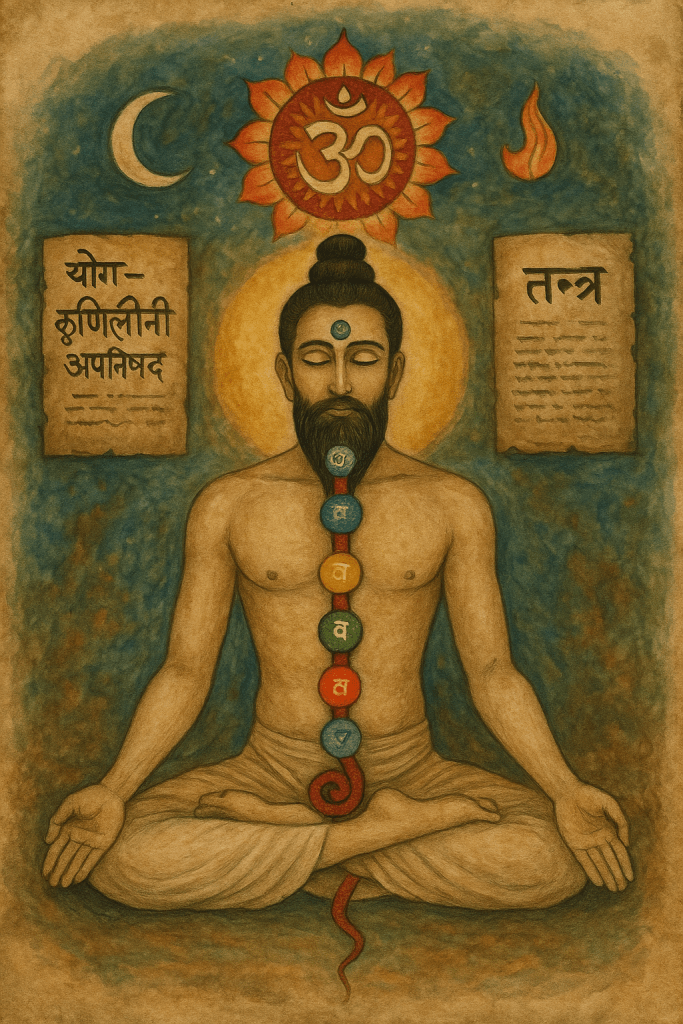
“This is a drop of water in the ocean of Kundalini Yogic knowledge… an ever-expanding science.” – Guru Singh
Kundalini Yoga is not the product of a single origin. It developed from multiple traditions within Indian spiritual thought and has continued to evolve. Rather than being defined by one teacher or scripture, it is a living, dynamic system focused on awakening human potential.
The practice integrates components from ancient disciplines such as Hatha Yoga, Raja Yoga, Tantra, and Sikh spiritual practices. These streams came together to form a method that works on the body, mind, and energy systems to produce transformation.
The roots of Kundalini Yoga are deeply embedded in the fertile soil of ancient Indian spiritual tradition. Long before it became known as a formal practice, the concept of awakening inner energy and uniting with the Infinite was encoded in the earliest sacred texts—the Vedas and the Upanishads. These scriptures described the soul’s longing to merge with the Supreme, and the energetic pathways through which this union could be realized.
Among the foundational texts, Patanjali’s Yoga Sutras gave us the eightfold path of yoga—ashtanga—outlining ethical foundations, physical disciplines, and meditative absorption as a roadmap to liberation. Yet it is in the Yoga Tattva Upanishad, a lesser-known but powerful Upanishadic text, that we find direct references to the awakening of Kundalini Shakti, the inner divine force. Here, the sages speak of asana, pranayama, bandha, and meditation not just as techniques, but as precise tools for inner alchemy.
Kundalini Yoga emerges at the intersection of multiple yogic streams—Hatha Yoga’s mastery over the body, Raja Yoga’s inner sovereignty of mind, and Tantra’s bold embrace of divine energy through embodied experience. It is this synthesis of yogic science and mystic application that forms the foundation for what we now call Kundalini Yoga: not merely a set of practices, but a living tradition of transformation.
In the mystical revelations of the Upanishads and Tantras, Kundalini appears not as symbol, but as presence—the primal force of creation itself. She is known as Shakti—the divine feminine energy coiled at the base of the spine, held in repose, luminous with infinite potential. Often described as a serpent resting in three and a half spirals, she mirrors the rhythm of the cosmos within the sacred temple of the human form.
To the ancient seers, Kundalini was the key to moksha—liberation of the soul—and the path to direct union with Paramatman, the Supreme Self. As she awakens and rises through the central channel of the Sushumna Nadi, she illumines the subtle body, dissolving distortion and initiating the flowering of the chakras. Each center opened becomes a gateway—revealing deeper dimensions of consciousness, clarity, and divine remembrance.
This knowledge was carried with care—passed in silence, gesture, and gaze from teacher to disciple. The journey with Kundalini was treated with sacred seriousness, approached through discipline, devotion, and deep purification. Not merely an energetic event, this awakening was a consecration—a returning to original resonance.
Kundalini was understood not as a force to be summoned, but as the indwelling intelligence of the Divine awaiting conscious relationship. She responds not to demand, but to devotion. Through dedicated practice, aligned living, and the grace of initiation, her presence stirs—gently, or all at once—restoring harmony within the self and reflecting the sacred order of the cosmos.
In this remembrance, the body becomes temple, the breath becomes mantra, and the inner coil begins to move—not as something new, but as something ancient rising once more.
Kundalini Yoga flows through many rivers of wisdom, and among them, the Sikh tradition carries a current of profound resonance. While the foundations of Kundalini rest in the ancient sciences of Tantra and Vedanta, its living transmission has also been shaped by the teachings and embodiment of Sikh saints and sages—those who walked the path of the householder-saint with unwavering presence.
These mystics practiced a form of Raj Yoga rooted not in retreat, but in remembrance through daily life. Their yoga was lived through action, service, and sound—anchored in the cultivation of inner sovereignty while moving through the world with devotion and dignity. This sacred orientation finds expression in three jewels of Sikh practice: Naam Simran, the continual remembrance of the Divine Name; Seva, the offering of selfless service; and Shabad Guru, the living presence of Truth awakened through sacred sound.
Each of these aligns deeply with the principles of Kundalini Yoga. The repetition of mantra becomes a vibrational pathway into subtle awareness. Service becomes a means of dissolving ego and awakening compassion. And sound itself becomes teacher—guiding consciousness beyond the limits of intellect into direct knowing. Through Gurmukhi mantras and the vibrational science of Naad, the Sikh influence within Kundalini Yoga carries both power and grace.
This is a yoga of the heart-centered warrior. A path of radiant discipline, where courage is cultivated alongside humility, and devotion is lived in the marketplace as much as the temple. The Sikh teachings offer a framework for embodying the Infinite while fully present in the finite—for honoring family, community, and dharma without losing the thread of divine remembrance.
Though Kundalini Yoga remains universal in its essence—beyond any one religion or lineage—the influence of the Sikh path contributes a luminous refinement: the invitation to walk this path not through renunciation, but through embodied sacredness. To stand in strength. To speak in truth. And to serve from the overflowing fullness of the awakened Self.
Interwoven through the current of Kundalini Yoga is the living transmission of the Sikh Gurus—a lineage of awakened souls who came not to form a religion, but to offer a path of divine remembrance for all beings. Their teachings form a bridge between heaven and earth, sung not in temples alone, but in the hearts of those who live with truth, courage, and compassion.
Guru Nanak Dev Ji, the first of the ten Gurus, walked across continents sharing a message that transcended caste, creed, and religion. He sang of One Divine Light shining through all, and of the sacredness of every breath. His wisdom flows through the Mul Mantra, the root vibration that opens the Sikh scripture—the Japji Sahib—and the hearts of those who chant it. This mantra is foundational in many Kundalini Yoga practices, for it contains the entire cosmology of Oneness in seed form.
Guru Ram Das Ji, the fourth Guru, is often called the Lord of Miracles and the Guru of the Heart. He is revered in Kundalini Yoga as the patron of healing, humility, and divine grace. His frequency is invoked in the healing mantra Guru Guru Wahe Guru, Guru Ram Das Guru, a sonic bridge to the space of sacred service and devotional strength.
Each Guru in the lineage brought through a unique aspect of divine realization—from the warrior-saint courage of Guru Gobind Singh Ji, to the radiant compassion of Guru Arjan Dev Ji, who composed many of the hymns that uplift the human spirit. Their legacy is not static—it breathes through sound, through service, and through the unbroken thread of the Shabad Guru.
Crucially, this lineage birthed not only teachings but also a technology of accessibility. At a time when Sanskrit was reserved for the Brahman elite, the Gurus gave rise to Gurmukhi—a script and vibrational language designed to carry the subtle power of sound while opening its doors to all. Gurmukhi retained the phonetic integrity and seed syllables of Sanskrit, but invited the common person into its sacred resonance. Through this act, sound became liberation.
The hymns of the Guru Granth Sahib—the eternal Guru of the Sikhs—are composed in Gurmukhi and embedded with Naad, the sacred sound current that reorganizes the consciousness through vibration. In Kundalini Yoga, these hymns and mantras are not chanted for worship, but for transformation. They are tools of refinement, tuning the inner instrument to the frequency of the Infinite.
To chant in Gurmukhi is to align the tongue, the palate, and the nervous system with patterns of light. It is to remember that the Divine is not only within—but speaking, singing, and pulsing through every word we utter with intention.
The Sikh Gurus did not ask for followers. They called forth sovereign beings. Their influence within Kundalini Yoga reminds us that awakening is not a privilege—it is a birthright. And sound is the doorway through which remembrance returns.
The late 20th century marked a significant turning point in the living story of Kundalini Yoga. In 1968, a man named Harbhajan Singh Khalsa—later known as Yogi Bhajan—arrived in the West and began teaching Kundalini Yoga openly for the first time. This act, once considered unthinkable, broke the long-standing tradition of secrecy that had protected this sacred science for centuries. His reason was clear: the world was entering a time of upheaval and accelerated awakening, and people needed real tools to meet the moment.
Kundalini Yoga, he taught, was not just for monks or mystics—it was for householders, healers, warriors of consciousness. It was time to share the teachings.
Through the creation of the Healthy, Happy, Holy Organization (3HO), Yogi Bhajan transmitted hundreds of kriyas, meditations, and lifestyle teachings rooted in yogic discipline, vegetarianism, and conscious living. His work catalyzed a global movement. While his legacy is complex—and in recent years, has come under rightful scrutiny—what remains undeniable is the access he provided. The teachings once hidden behind closed doors now live in yoga studios, community circles, and hearts around the world.
One of Yogi Bhajan’s earliest and most resonant students was Guru Singh—a radiant teacher, musician, and mystic who carries the flame of this lineage with grace and evolution. A third-generation Kriya Yogi and ordained minister, Guru Singh became a guiding voice in the refinement and expansion of Kundalini Yoga for a new era. His name, Guru Sing, speaks to the frequency he embodies: one of song, sovereignty, and soul.
With a gift for bridging worlds, Guru Singh brought Kundalini Yoga into conversation with modern psychology, emotional alchemy, and energetic science. His teachings honor the ancient while inviting innovation. Drawing from Daoist Qi Gong, bioenergetics, and vibrational medicine, he reminds us that the evolution of practice is not dilution—it is deepening.
This chapter in the Kundalini Yoga lineage is one of reclamation. A shift from secrecy to sacred sharing. From guarded esoterica to awakened community. It affirms that spiritual tools are not meant to be hoarded, but offered in devotion and discernment.
It is in this spirit of remembrance and responsibility that this course has emerged. To walk this path now is to honor all who carried it—and to carry it forward, not as dogma, but as living light.
To walk this path is to walk with reverence, with listening, and with inner discernment. The story of Kundalini Yoga as it has emerged in the West carries many threads—some luminous with sacred transmission, some shaped by the complexities of human leadership. Each carries a teaching. Each invites awareness.
I give thanks for those who opened the gateway, including Yogi Bhajan, whose sharing helped bring these teachings to the surface of collective consciousness. At the same time, I walk independently of any institution. This offering is not affiliated with 3HO, KRI, or any formal body. What lives here arises from the current of direct experience.
My practice and teaching flow from an inner source—refined through deep self-inquiry, rooted in the wisdom of lived transformation. I honor the guidance of my teacher, Guru Singh, whose presence carries the clarity, sovereignty, and devotion that inspire this next unfolding of Kundalini Yoga. Through his voice, I have witnessed the lineage evolving—not as a structure, but as a song.
This course arises from that song. From a transmission that lives and breathes in real time. What is offered here does not seek to replicate or preserve a model—it seeks to resonate with truth. In this resonance, a new integrity is revealed. One that honors essence above form, and presence over performance.
Lineage, in this light, becomes a river. A stream of remembrance that flows through all who open themselves to the call. The teaching lives where the soul listens.
My role is to hold space for your return to that listening. To offer tools, reflections, and resonance that awaken what already lives within you. Here, we meet not in hierarchy, but in harmony. Not through belief, but through direct knowing.
This is the path I walk—transparent, devotional, and ever unfolding. May these teachings serve your awakening with grace. May you come home to the teacher already alive in you.
Kundalini Yoga is not bound by history—it is a living current of spiritual intelligence, flowing with the rhythms of transformation. It breathes with the world, responds to the moment, and evolves with the heart of humanity. What once moved through whispers in forests and caves now resounds in breath, chant, and remembrance across continents. And still, the essence remains unchanged: a sacred dance of movement, sound, and stillness that stirs the soul awake.
This path lives because you live. Each step you take, each breath you offer, becomes part of its unfolding. Your joy, your sorrow, your devotion, your becoming—all of it shapes the current. In this way, the lineage is not behind us—it moves through us. Alive in your presence. Illuminated in your practice.
What you will find here is a synthesis—a weaving of ancient yogic science, tantric alchemy, Sikh devotion, subtle energy anatomy, and mystical embodiment. These threads do not bind—they liberate. For this path does not belong to any one system, tradition, or teacher. It belongs to the pulse of consciousness as it blossoms through time.
You are not here to fit into a mold. You are here to open the channel. And through that opening, you carry the teachings forward—not by preserving them, but by becoming them.
This is a living path—fluid, luminous, and rooted in direct experience. It reveals itself not through doctrine, but through devotion. And as you walk it, you will not be asked to believe—you will be invited to remember.
Welcome to Kundalini Yoga, not as it was, but as it now breathes. Welcome to the current that moves through you. Welcome to the unfolding of your radiant Self.
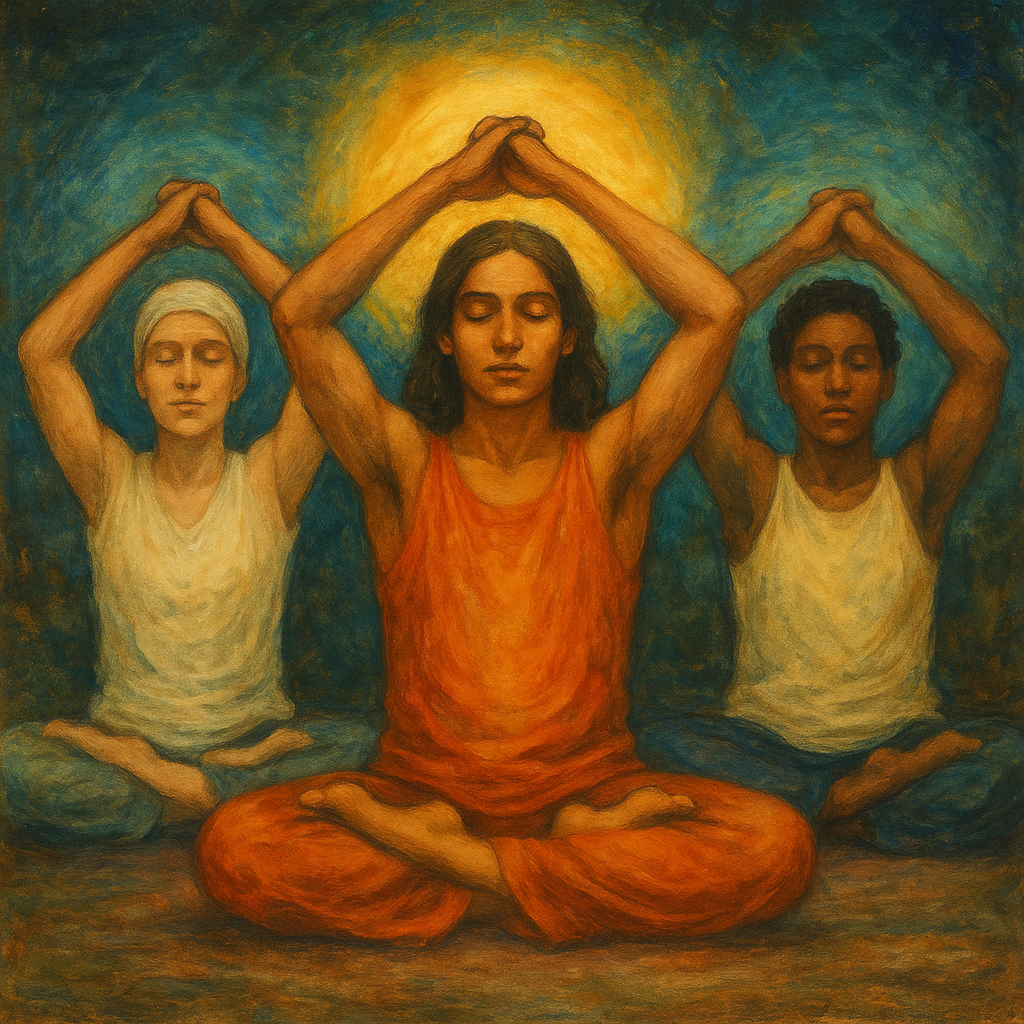
Kundalini Yoga taps into the transformational architecture of yoga as illuminated in the Yoga Tattva Upanishad—a sacred text that expands upon the foundational framework laid by Patanjali in the Yoga Sutras. Where Patanjali maps the psychological and ethical terrain of liberation, the Yoga Tattva Upanishad offers the keys to embody that liberation through precise, energetic practice.
This manual of inner alchemy reveals a progressive path: beginning with the purification of body and breath, advancing through energetic locks and subtle seals, and culminating in deep states of meditation and union. It teaches that the aim of all yogic effort is stillness—not absence, but presence beyond movement—where the finite dissolves into the Infinite, and transformation becomes a lived reality.
The alchemy of Kundalini Yoga becomes tangible through daily practice, or Sadhana. Sadhana is not a task—it is a temple. A space we enter each day before the world awakens, to commune with soul and tune the instrument of self to the resonance of the Divine.
As this discipline deepens, it ripens into Aradhana—a devotional posture of life itself, where practice is no longer separate from presence. Aradhana is the natural transition where our entire life becomes sadhana. The separation of “daily practice” and “the rest of my day” blurs, and we begin to honor all routine and spontaneity as sacred, with intention of attention given to every aspect of life and thus automatic patterns of reaction becoming minimized.
From here, the path opens into Prabhupati—not control, but surrender to the Sovereign Self, where the subconscious is purified, the conscious is refined, and the human becomes a radiant vessel of awakened energy. A state of Prabhupati is a state of transcendental presence which extends to our waking, sleeping, and dreaming states of consciousness. Our higher awareness of Self becomes the supreme state of life. Old cycles of harm, distortion, frustration, etc., dissolve and our intention allows for us to choose our state of being in any moment or situation. Life itself restructures around us to meet our intention in any given momement.
In the Yoga Tattva Upanishad, the sacred sequence of yogic development begins with asana, followed by pranayama, mudra, and bandha—culminating in deep meditative absorption. Kundalini Yoga honors this progression, yet expresses it through a living, cyclical design: an interwoven dance where each layer of practice repeats and evolves in harmony. This sacred choreography is called Kriya.
Kriya means “Complete Action.” Not simply movement, but a catalytic formula—each one a consciously constructed pattern of breath, posture, sound, and focus. These are not random routines, but vibrational blueprints. Each Kriya generates a specific impact—physiological, emotional, and energetic—shifting the system from inertia into flow, from fragmentation into integration.
In its deeper sense, Kriya is the conscious sculptor of Karma. Kriya and Karma are not separate—they are intertwined currents. Karma is the impression, and Kriya is the intentional wave that clears or rewrites it. Through deliberate practice, we begin to sow new energetic seeds: impressions born not of reaction, but of awareness—coded not with repetition, but with liberation.
Each Kriya becomes a sacred act of authorship. A way of inscribing light into the body, clearing density, and re-patterning the inner field. What once echoed from the past begins to sing from the soul. As discipline deepens into devotion, the practitioner shifts from cycling karmic memory to sculpting destiny.
This is the subtle fire of Kundalini: not to perform for outcome, but to transmute for freedom. Kriya reshapes not only how we move—but who we become.
Asana is more than posture—it is presence made visible through the body. In the practice of Kundalini Yoga, asanas are not isolated exercises for flexibility or fitness, but intentional mudras of the body that open pathways for energy to flow and awareness to rise. Each form, each shape, is a key—unlocking gates within the subtle terrain.
Where classical traditions may hold postures in stillness, Kundalini kriyas often move. Breath, mantra, and rhythm pulse through the form, making the body a vessel not of performance but of transformation. Each asana becomes an invocation—awakening dormant capacities, rewiring nervous currents, and inviting the Infinite to dwell within the finite frame.
Through consistent and conscious application, asana offers:
- Spinal alignment and vertical integrity, supporting the unimpeded ascent of Kundalini through the central channel (Sushumna)
- Regulation of the nervous system, strengthening the capacity to meet intensity with grace
- Release through fascia and subtle layers, amplifying the body’s ability to conduct and circulate energy
- Stimulation of the parasympathetic response, softening the edges of overactivity into grounded ease
- Balancing of endocrine secretions, supporting emotional clarity and hormonal equilibrium
- Strengthening of the skeletal frame, generating marrow vitality and structural confidence
- Detoxification through lymphatic flow, cleansing what no longer serves and awakening vitality
- Dissolution of muscular armor, creating space for the subtle self to emerge
- Joint mobility and connective tissue alignment, offering fluidity, resilience, and grounded adaptability
- Circulatory enhancement, enriching the bloodstream with pranic vitality and oxygen
- Proprioceptive awakening, deepening one’s grace, balance, and intimacy with embodiment
In this light, asana becomes a ritual of preparation—an offering of readiness. The body is tuned not just for motion, but for reception. Not just for health, but for holiness.
This is the seat from which stillness arises. The foundation upon which the light may descend.
This is the sacred geometry of becoming.
Pranayama is the yogic art of breath—prana meaning life-force, ayama meaning expansion, regulation, or rhythmic extension. It is not just a practice of inhaling and exhaling, but a conversation with the Infinite through the most intimate movement we know. Prana is not merely oxygen—it is the luminous current that animates all of life. And through breath, we touch its essence.
In Kundalini Yoga, breath is never passive. It is directed, designed, devotional. Every kriya pairs movement with specific breath patterns to sculpt the inner terrain—guiding prana into meridians, clearing emotional debris, and restoring rhythm to the inner tides. The breath becomes bridge, balm, and blueprint. Each inhale is a receiving—of vitality, clarity, and grace. Each exhale, a release—of memory, of tension, of all that is ready to return to Source. And between them, the holding of sacred pause—kumbhaka—a moment outside of time where being and becoming dissolve into stillness.
Pranayama gently opens the three primary energy rivers: Ida Nadi, flowing through the left nostril and associated with lunar, cooling, intuitive energy; Pingala Nadi, flowing through the right nostril and associated with solar, warming, activating force; and Sushumna Nadi, the central channel of the spine through which Kundalini ascends when balance is restored. Breathing through the nostrils creates rhythmic pulsations along the spine and brainstem, regulating the autonomic nervous system and preparing the Sushumna to awaken. As the Kundalini Light rises, it also returns—cascading through the Vagus nerve into the parasympathetic field, grounding illumination into embodiment.
Some foundational breath techniques include:
- Long Deep Breathing – A three-part breath expanding the diaphragm, ribs, and chest. This breath anchors awareness and invokes serenity. It draws the soul back into the body.
- Accelerythmic Breathing (Breath of Fire) – A rapid, rhythmic breath powered by the navel. Equal inhale and exhale through the nose, stimulating the aura, igniting inner fire, and purifying the bloodstream.
- Sitali Breath – Inhale through a curled tongue (or through teeth over the tongue if curling is not possible for you), drawing coolness into the system; exhale through the nose. A balm for digestive heat, inflammation, and emotional reactivity.
- Ujjayi Breath – With a gentle throat constriction, inhale and exhale through the nose to create an oceanic sound. This breath steadies the mind, fuels inner warmth, and deepens meditative absorption.
Through pranayama, we become the sculptors of our own inner sky, shaping our state of being through the subtle instrument of breath. It is here that transformation is not forced, but invited—where breath becomes both guide and gateway into the mystery of stillness.
Bandha refers to internal locks that guide pranic flow through the subtle body. In the living tradition of Kundalini Yoga, we attune to both the physical and energetic dimensions of the self. The spine becomes a sacred channel, and the chakras—seven primary centers of intelligence—are awakened as portals of remembrance. From the root of the spine to the crown of the head, energy rises like sap through a tree, drawing forth our inner flowering. The Bandhas offer support to this ascent, stabilizing the inner architecture as higher frequencies move through.
Though the word Bandha means “lock,” the act is not one of restriction—it is one of refined direction. These energetic seals regulate flow, allowing life-force to gather, build, and rise with grace. When held with sensitivity, they support the body in becoming a container for consciousness, a vessel strong enough to hold light.
Each Bandha corresponds to a key point along the central channel, offering structure and safety for the journey inward:
Mula Bandha activates the base of the spine, awakening awareness in the pelvic floor and perineum. This region, home to Muladhara Chakra, governs safety, stability, and instinctual intelligence. Rather than letting energy dissipate downward, the Root Lock gently gathers and lifts it—anchoring the base so the ascent may begin.
This lock may be applied through subtle engagement of the pelvic floor or through directed breath that presses the abdomen downward while lifting the inner root. With regular practice, this action becomes a devotional gesture—a sealing of the foundation, a signal to the body that it is safe to rise.
Uddiyana Bandha is applied by drawing the belly inward and upward beneath the ribcage, typically after exhale. This action stirs the Manipura Chakra, the center of inner fire, will, and digestion—both physical and energetic.
The diaphragm holds deep memory. Often, it is where stress, fear, and unspoken grief reside. Through conscious breathing and rhythmic practices like Breath of Fire, we loosen this area and reclaim the power within it. As Uddiyana Bandha is gently cultivated, it supports the movement of energy from the lower centers toward the heart. Here, fire becomes transformation. Heat becomes clarity.
Rather than forcing energy upward, we create space for it to rise. The body opens. The will softens into willingness.
Jalandhara Bandha is formed by gently tucking the chin toward the chest while lifting through the heart. This posture tones the Vishuddha (throat) Chakra, center of expression, purification, and spiritual refinement.
When Kundalini energy nears the higher centers, the intensity of awakening must be integrated with care. Jalandhara Bandha supports this by regulating the upward surge, allowing the current to circulate without overwhelming the mind or nervous system. The pressure applied at the throat stimulates the thyroid, soothes the vagus nerve, and creates a loop of containment through the spine.
This lock teaches discernment. It brings balance between expression and silence, motion and stillness. With it, we learn to hold the charge of truth without losing center.
When all three Bandhas—Mula, Uddiyana, and Jalandhara—are applied together, we enter the state of Maha Bandha, the Great Lock. In this union, the body becomes a living yantra—a sacred form through which energy moves in precision and harmony. This is not something to force or rush. Maha Bandha arises naturally through devoted practice, when the system is ready to hold its own awakening.
As the locks engage, a quiet pulse begins to build—like a drum sounding in the hollow of the spine. It is the rhythm of remembrance, the body returning to its blueprint of wholeness. The vessel is sealed not to contain, but to consecrate. You become the chalice. The light pours in.
Mudra is the language of the subtle body. Through intentional gestures of the hands or positioning of the body, we awaken dormant pathways, redirect prana, and enter states of refined awareness. The word mudra means “seal,” yet it is also a key—an energetic signature that opens inner doors, guiding the nervous system toward balance and the spirit toward integration.
In Kundalini Yoga, mudras are never ornamental. They are codes of connection, woven through the fingertips and bones. With each gesture, we are not only shaping our hands—we are shaping our consciousness. These sacred forms create closed loops of energy that stabilize, amplify, or refine the internal current. When used in harmony with breath and mantra, they deepen the potency of kriya and the receptivity of meditation.
Each finger represents an element of nature and a force within the psyche. When fingers join the thumb—symbol of fire and divine will—an energetic conversation begins. Circuits close. Currents shift. The body listens.
In the womb, the hands are formed as extensions of the heart-brain axis, their buds sprouting from the same embryonic tissue that shapes the skull. Though they eventually separate and grow outward, they remain intimately linked—neurologically and energetically—to the brain and the emotional body. Each fingertip becomes an endpoint in the vast map of the nervous system, a sensitive antenna of perception and intention. Modern science confirms what yogis have long intuited: when we touch specific fingers together, we activate corresponding areas of the brain, influence neurochemical states, and initiate measurable energetic changes in the body. Mudras, then, are not symbolic alone—they are somatic invocations, opening precise pathways that bridge the physical and subtle realms.
| Finger | Element | Planet | Quality/Function |
|---|---|---|---|
| Thumb | Fire (Agni) | Mars | Willpower, ego, action, transformation |
| Index | Air (Vayu) | Jupiter | Wisdom, expansion, knowledge, self-direction |
| Middle | Ether (Akasha) | Saturn | Discipline, patience, responsibility |
| Ring | Earth (Prithvi) | Sun | Vitality, strength, stability, physical health |
| Little | Water (Jala) | Mercury | Communication, intuition, emotions, flow |
By calling these forces into intentional relationship, each mudra becomes a ritual act of inner attunement—a way of sculpting the unseen.
Gyan Mudra – Seal of Knowledge
- How: Touch the tip of the index finger to the tip of the thumb. Other fingers extend gently.
- Effect: Cultivates mental clarity, intuitive receptivity, and a calm nervous system. Balances the air element and supports focus during meditation.
- Use: A foundational mudra in Kundalini Yoga, often paired with mantra or breath practices to quiet the mind and deepen insight.
Shuni Mudra – Seal of Patience
- How: Touch the middle finger to the thumb.
- Effect: Anchors Saturnian energy—discipline, perseverance, maturity. Supports long journeys of healing and transformation.
- Use: Helpful in kriyas requiring steadiness or in practices focused on overcoming resistance and building inner strength.
Anjali Mudra – Seal of Devotion (Prayer Pose)
- How: Bring palms together at the heart center, thumbs resting lightly against the sternum.
- Effect: Balances the hemispheres of the brain, centers awareness in the heart, and evokes humility, gratitude, and reverence.
- Use: Commonly used at the beginning and end of practice, or when offering mantra as prayer. Aligns outer action with inner sincerity.
Bhujangini Mudra – Bear Grip / Shiva-Shakti Mudra
- How: Place left palm outward and right palm inward at the heart. Interlace fingers like hooked claws and pull gently without releasing.
- Effect: Activates the heart center, builds magnetic charge between polarities, and stimulates deep willpower. This mudra channels the union of Shiva (consciousness) and Shakti (energy).
- Use: Often held during breathwork or mantra to awaken the Anahata Chakra and strengthen emotional and energetic resilience.
Venus Lock – Seal of Creative Power
- How: Interlace fingers with palms facing inward. For women, left thumb over right; for men, right over left. Rest the mudra below the navel.
- Effect: Harmonizes sexual and creative energies. Stabilizes the lower triangle (root, sacral, navel) and prevents energy leakage through the downward pathway.
- Use: Common in meditations with breath retention or deep internal focus. Grounds the practice in presence and allows Kundalini to gather and rise with integrity.
Mudras are not simply hand shapes—they are gestures of alignment. Each one speaks to the subtle body in its own dialect, reminding the system how to harmonize, how to return, how to remember. Practiced with breath and presence, they refine the circuitry of our being and offer stillness without stagnation, power without pressure.
In the sanctuary of the palms, ancient wisdom lives.
In Kundalini Yoga, Drishti is more than a location—it is a portal of perception. Derived from the Sanskrit for “point” or “drop,” Drishti represents the concentrated seed of awareness where intention and energy converge. It is the nucleus of inner attention, the sacred locus from which we navigate both the interior realms and the world around us. In this way, Drishti is both origin and instrument—through it, we receive, focus, and transmit.
Attention is creative. Where we place it, energy flows. Drishti becomes the compass of consciousness—subtle, potent, and precise. Most often, this focus centers on the third eye point (Ajna Chakra), located slightly above and between the eyebrows. With a gentle convergence of the gaze—eyes closed or softly directed upward—we stimulate the pineal region and awaken intuitive vision. Neurologically, this inner gaze harmonizes the hemispheres of the brain, reducing cognitive noise and ushering in deep meditative absorption.
At other times, the Drishti shifts to the tip of the nose, with the eyelids nine-tenths closed. This practice stills the thought-stream, cools the emotional body, and steadies the energetic field. It is especially grounding after intense kriya or during mantra repetition, creating a doorway into presence through physical and psychic stillness.
Over time, Drishti becomes more than a point of focus—it becomes a radiant transmitter. From this subtle center, we learn to project awareness outward: visualizing light, guiding healing, transmitting prayer, or expanding compassion into the field. What begins as inward concentration matures into outward resonance. The practitioner becomes a living mandala—rooted in stillness, radiating intention. This is the mastery of Drishti: the art of wielding awareness as the axis of transformation.
Mantra transmits what cannot be spoken. In Kundalini Yoga, sacred sound opens the path. Many mantras emerge through Gurmukhi, a lyrical script shaped by devotion and remembrance. While Sanskrit preserved its brilliance in formal tones, Gurmukhi flowed through the people—melodic, rhythmic, and alive in the heart. Each vibration carries the essence of the One, inviting the voice to become the bridge where finite expression meets infinite presence.
Mantra moves as frequency. Everything breathes in vibration—thought, emotion, memory, matter. When resonance wavers, when the field holds the echo of suffering, mantra steadies the wave. It restores harmony not by force, but by attunement. The subtle body begins to listen again. Patterns soften. Light returns to the soundscape within.
Mantra is vocal alchemy—each syllable a key, each breath a flame.
Chant not only with the lips, but with your field. Let the sound ring through the body, clarifying the places that have waited to be heard. Over time, the mantra listens back, and what remains is coherence, clarity, and deepening presence.
Mantra shapes consciousness through both resonance and form. Vowels open the field—like bells awakening the energy centers. Consonants guide the current, sculpting subtle pathways through the touch of tongue to palate. This area contains 84 meridian points, linked directly to the hypothalamus, pituitary gland, and entire endocrine system. Each utterance becomes a signal, each pattern a message of balance.
Through this sacred interface, sound becomes command. The nervous system, emotions, and mental states reorganize around the intention carried in tone. The body, like an instrument, remembers how to play its original music.
This is living spellwork—sound weaving spirit and substance. Through mantra, the auric field refines its geometry, softening distortion and brightening the lattice of light. Magnetic resonance deepens. The voice becomes a tuning fork for reality. As your vibration steadies, the outer world echoes its harmony. What is spoken in wholeness returns as alignment.
As the sound flows, the Self reveals. As we speak, we shape the path.
At the start of every practice, we attune through the Adi & Mangala Charan mantras. Sacred sounds draw the field together—body, breath, and subtle awareness aligning the head, heart, and gut brains into coherence.
Likewise, through the practice, we carry the internal mantra of “Sat Nam”, to keep our mind and attention focused on the identification of truth that permeates our deepest reality.
These mantras hold memory and momentum. They open space, invoke guidance, and call forth the quiet brilliance of inner knowing. Through them, we enter not only a kriya, but a current that carries us deeper into who we already are.
Below are the common mantras used in Kundalni Yoga classes:
In Kundalini Yoga, Sat Nam is the mantra of origin and return. It is the sound we come home to—aloud, in silence, in movement, in stillness. A seed syllable placed at the center of breath, it grows roots through the body and blossoms through the field.
Sat (सत्) carries the vibration of truth, essence, and being.
Nam (नाम) offers the current of identity, name, and sacred bowing.
Together, they speak not as words, but as a pulse:
“Truth is my identity.”
This mantra breathes with you—
- Inhale: receive the sound of SAT
- Exhale: release through the sound of NAM
With every breath cycle, mind and spirit return to alignment. The nervous system harmonizes. The subconscious begins to clear. Through repetition, the mantra etches a rhythm of remembrance into the subtle layers of awareness. It becomes the quiet resonance beneath thought. A tuning of soul to Self.
Sat Nam becomes more than a mantra. It becomes signature—echo, compass, name. It moves through the voice, but also through presence, through gaze, through the way one walks the world.
Adi Mantra
ONG NAMO
GURU DEV NAMO
“I bow to the Divine Wisdom of All That Is,
I bow to the Divine Teacher within.”
Before each practice, we chant this sacred mantra three times to enter the current of remembrance. It harmonizes the three centers—mind, heart, and gut—so that we may receive, listen, and act from a space of integrated awareness.
It is a sonic invocation, not just to begin, but to align—to step consciously into the field of living wisdom, and allow our practice to unfold from within the stream of the Infinite.
Mantra as Pathway
Ong – Resonates from the third eye and rises through the crown. This is the Infinite in motion—creative, alive, embodied. The tongue presses the upper palate, activating meridian points and awakening subtle intelligence. Unlike OM, which dissolves into spacious silence, Ong vibrates the world into presence.
Namo – A bowing, not in submission but in reverence. This sound roots the transmission of Ong into the gut center, grounding vision into intuition and trust.
Guru Dev – The luminous bridge: Gu (darkness), Ru (light), Dev (divine). This phrase opens the channel through the throat and heart, calling forward the radiant clarity within all beings. It is not a call to an outer teacher, but a recognition of the ever-guiding light within.
Namo – The mantra completes its circuit, returning once more to the ground of humility, sealing the field in centered presence.
Directions:
- Sit comfortably with a long, lifted spine.
- Rub the palms together with intention—awakening the nadis, inviting the body into presence.
- Place the hands in Anjali Mudra (Prayer Pose) at the heart:
- Palms press together, thumbs lightly touching the sternum.
- Elbows rest gently or float slightly outward.
- This creates a circuit of awareness from the spine to the hands and back again.
- Chant: “Ong Namo Guru Dev Namo” three times, in one breath if possible.
- If the breath naturally needs replenishing, a quiet inhale may be taken before Guru Dev.
- Let each repetition be a tuning, not a performance.
Through this mantra, we do not begin—we awaken. We place ourselves in the stream of timeless wisdom, tuning our voice and body to the frequency of lineage, guidance, and the unfolding of the soul.
Mangala Charan Mantra
Aad Guray Nameh
Jugaad Guray Nameh
Sat Guray Nameh
Siri Guru Dev-ay Nameh
“I bow to the Primal Wisdom;
I bow to the Wisdom of the Ages;
I bow to the Wisdom of Truth;
I bow to the Wisdom of the Inner Light within us all”
This mantra is a sacred shield: A current of clarity, a luminous bridge between Self and Source.
Following the Adi Mantra, we continue with the Mangala Charan Mantra, chanted three times to anchor the field of protection and presence. This mantra weaves light through the aura, strengthens the magnetic field, and tunes the heart to divine guidance. It does not only surround—it radiates from within, harmonizing the space around you with the frequency of trust, clarity, and grace.
With palms still in Anjali Mudra and the chin gently tucked in Jalandhar Bandha, the mantra unfolds through sound, and visual intention. Let your imagination envision a wall of brilliant light protecting each direction of the room with each line of the mantra.
As the sound flows from your lips, allow your awareness to flow outward—beyond thought, beyond space. Let your heart project the vibration through the unseen realms, calling forth the subtle forces of support, remembrance, and radiant alignment. This is a mantra of arrival and invocation, a sacred cloak woven of sound and sincerity.
You enter the kriya encircled by light—not only shielded, but luminous. Not only guided, but guiding.
Between the breath and the beat, there is a place where everything resettles into harmony. That place is you.
In Kundalini Yoga, relaxation is not rest—it is revelation. It is the subtle sanctuary where effort transforms into integration. After movement or asana, we gather the current with a long, conscious inhale, sealing it through the Bandhas—root, navel, and sometimes throat. These inner locks unify the energetic flow, condensing the prana like nectar in the spine.
Then, as we exhale, we release into stillness.
This is the pause that speaks. It’s where prana reveals its path—rising, merging, returning. In these breathless moments, awareness deepens. We don’t seek sensation—we feel what is already there. The body listens. The soul settles. The kriya begins to echo in the subtle field, not with noise, but with knowing.
In the silence between actions, the work continues in ways the mind cannot measure.
At the completion of a kriya, before mantra meditation, we enter Savasana—the final relaxation. Lying flat on the back, arms by the sides, palms open, the body surrenders its effort and the spirit opens to receive. Feet fall gently apart. Eyes soften or close. The entire being reclines into presence.
This is not an ending. It is a sacred interlude.
Here, the frequency of the kriya integrates into the cells, the aura re-patterns, the nervous and glandular systems calibrate to a new coherence. What was once moved through breath and will now flows through grace. Insights may emerge. Emotions may pass. A subtle reweaving takes place.
Savasana is the body’s way of saying: I heard you. Now let me respond.
We honor relaxation not as collapse, but as completion. A threshold between doing and being. It prepares the inner sanctuary to sit in mantra—not with effort, but with openness. Not with striving, but with surrender.
In this stillness, the practice becomes whole.
When breath becomes rhythm and sound becomes intention, the soul remembers its own name.
Every kriya in Kundalini Yoga leads naturally into mantra meditation—not as an afterthought, but as a sacred completion. It is here that the energies we’ve awakened are refined, sealed, and offered to the Infinite. Each meditation is carefully attuned to the vibration of the kriya, creating a resonance between inner transformation and outer expression.
This is a transmission through presence. Through mantra, mudra, and focused awareness, we etch new pathways in the nervous system, soften mental resistance, and allow the frequency of the practice to permeate the deeper layers of being. Mantra becomes the echo of what we’ve moved, the melody of what we’ve opened.
These meditations are not arbitrary—they are vibrationally designed. Each sequence of syllables, each gesture, each gaze has its own blueprint. The durations follow sacred rhythm—3, 5, 7, 11, 22, or 31 minutes—each unlocking a unique octave of awareness. These numbers are not just time—they are thresholds.
Three minutes alters the aura. Eleven minutes touches the glands. Thirty-one minutes rewrites the subconscious.
Chanting aloud awakens a current that begins at the navel, rises through the heart, and resonates through the crown. As the tongue touches the roof of the mouth, it activates meridian points that stimulate the hypothalamus and harmonize the brain’s chemistry. With each repetition, we imprint the mantra deeper into the subtle body.
We do not chant to believe—we chant to become.
Through consistent practice, mantra meditation becomes self-initiation: a living bridge between thought and transcendence, effort and grace. It is the sound of liberation spoken through your own voice—guiding you home again and again.
Sample Meditations
“Sun, Moon, Earth, Infinity, Totality, I Am Thou”
Purpose: A powerful healing mantra that calls on the cosmic forces of nature and spirit to bring restoration and renewal.
Ra (Sun) – energizing, life-giving
Ma (Moon) – cooling, reflective
Da (Earth) – grounding, nourishing
Sa (Infinity) – elevating, universal
Say (Totality) – embodiment of the infinite
So Hung – “I am Thou,” the merging of individual with universal consciousness
Use: Often chanted in a seated posture with hands in Gyan Mudra or healing mudra (right hand over left at the heart). Practiced for healing the self or sending healing to others.
“Truth is my Identity, Ecstatic Wisdom,
Ecstatic Wisdom, Truth is my Identity”
Purpose: Balances the identity (Sat Nam) with the ecstatic experience of the Infinite (Wahe Guru).
Sat Nam – Truth is my identity
Wahe Guru – Surpreme joy of the light that shines in darkness – the inner teacher.
Sat Nam grounds you in truth, Wahe Guru expresses the joy of spiritual awakening
Use: A balancing mantra that connects inner knowing with ecstatic awareness. Often paired with cross-heart mudra (right hand over left on the chest) or Venus Lock, and eyes gently focused at the third eye.
A powerful pranic ignition mantra, translated loosely as :
“I bow to the force of creative consciousness vibrating in all dimensions.”
Purpose: Charges the magnetic field, ignites the breath, and opens energetic portals for transformation.
OM – Universal vibration
ONG – Creative vibration moving through matter
BRUM – Protective, grounding force
HUM – Spirit anchored in the body
NAMO – I bow
Use: Often used at the start of a deep pranic kriya or meditation. Can be chanted rhythmically or in long tones. Eyes focused at the tip of the nose or brow point.
“The One Creator and Creation are united.
This Truth is known through the Teacher within.”
– Purpose: Known as the Adi Shakti Mantra or the Morning Call, this mantra activates the Kundalini energy, opens all chakras, and establishes the infinite identity within the practitioner.
– Ek Ong Kar – One Creator-Creation
– Sat Nam – Truth is my Identity
– Siri Wahe Guru – Great, indescribable ecstasy of awakening
Use: Practiced with specific breath rhythms, often lying down or seated in easy pose. Eyes are kept at the third eye, and the mantra is drawn out in long, resonant syllables over a single inhale or segmented breaths.
Kundalini Yoga is not a performance. It is a listening. A remembrance. A sacred technology that tunes the instrument of the self until it becomes transparent to the Infinite.
Each breath, each posture, each mantra—these are not steps to follow, but threads in a larger weaving. Together, they form a tapestry of transformation where energy becomes awareness, and awareness becomes love.
This practice does not require perfection. It asks only presence.
With every kriya, you soften the shell of separation. With every meditation, you open space for the soul to breathe. The body is purified, the heart is revealed, and the mind begins to bow.
You are not becoming something new. You are returning to what has always been whole.
So walk this path with tenderness and trust. Let the breath guide you. Let the silence teach you. Let the sacred sound within you become the voice of your own awakening.
This is not the end.
It is the pulse before the stillness.
The inhale before the mantra.
The remembering that you, too, are light.
Before we step into the current of Kundalini Yoga, we pause at the threshold in reverence.
Preparation becomes the first movement of devotion. The way we enter informs the tone of our experience. As we tend to the inner and outer atmosphere, we shape a vessel spacious enough to welcome the energies this practice awakens.
Kundalini Yoga moves beyond physical form; it is a sacred current that touches the nervous system, subtle body, emotional layers, and the unseen architecture of consciousness. When approached with care and conscious setup, the kriyas unfold with deeper harmony and resonance. Like tuning an instrument before sound is offered, we attune ourselves to become receptive and precise, resting in rhythm with the pulse of awareness.
This chapter offers reflections on readying body, mind, and space for the sacred work of practice. It offers invitations for grounding and safety, for opening to yogic initiation, and for sustaining the steady rhythm of sadhana as a way of being. These considerations are frameworks for anchoring into integrity, sensitivity, and grace.
What follows is not a rhythm of remembrance. Each breath, each gesture, each preparation is a doorway, welcoming the Infinite as the presence unfolding in the way we enter, the way we listen, the way we begin.
The outer field echoes the inner sanctuary. As we prepare a space with care and intention, we invite the deeper layers of awareness to awaken. Over time, this environment becomes charged with the quiet current of devotion—a living temple where remembrance stirs and presence deepens.
Choose a setting that welcomes stillness and simplicity. Spaciousness arises not from size, but from coherence. Let the area be clean, undisturbed, and attuned to gentle presence.
Dimming the lights, silencing technology, and shaping the perimeter with subtle cues helps the nervous system settle.
When practicing under open sky, seek a natural space that feels held—where earth and atmosphere meet in quiet harmony.
An altar may emerge as a simple gesture: a candle, a stone, a sacred image, or a symbol that mirrors your intention.
This becomes a point of return for the wandering mind, and a beacon of reverence within the space. Lighting incense, placing flowers, or arranging offerings becomes an act of inner alignment—a reflection of devotion rather than display.
Many practitioners align toward the east, the direction of illumination and renewal. This ancient orientation harmonizes with the solar rhythm and invites the subtle body to rise with the current of awakening.
Other directions may also call, each holding a resonance. Attune to what feels aligned for your practice and let your own inner compass be the guide.
Adorn yourself in what allows ease, freedom, and quiet dignity. Breathable natural fibers like cotton or linen support the movement of prana and offer comfort to the skin.
In Kundalini Yoga tradition, white attire is often worn to amplify the auric field and support luminous awareness, and head coverings are used to steady the crown space.
These are offered as tools, not mandates. Choose what helps you feel open, steady, and fully present as you enter the sacred rhythm of practice.
The body is a sacred conduit—an expression of Infinite intelligence in form. When approached with care, it becomes a clear channel for subtle energies to move, rise, and reveal their deeper rhythm. Preparation is more than a step before practice, it is the quiet beginning, where intention enters and the current begins to stir.
Enter your practice in a state of lightness. When the stomach is spacious—often 2–3 hours after a meal—the inner winds move with greater ease. If nourishment is needed beforehand, a gentle offering of fruit, soaked nuts, or herbal tea can sustain without grounding the energy too deeply.
Let hydration flow throughout the day, refreshing the tissues and clearing the subtle channels. Right before practice, small sips may support; generous drinking is best reserved for after the current has settled.
The space within becomes a vessel of expansion. The breath travels freely, and prana ascends like incense from an unburdened flame.
Washing the hands, face, and feet invites both clarity and respect. In yogic rhythm, this act an act of hygenic devotion.
Each rinse dissolves residue, each drop blesses the threshold. As you cleanse the body, the field responds with readiness.
A few drops of rose water, a touch of sandalwood oil, or the coolness of clear water at the brow or heart can become a silent offering which anoints presence to the altar within.
The way the mind is met shapes the path that follows. As you arrive at the doorway of practice, the invitation is not to still the mind by force, but to acknowledge it with compassion.
This is a beginning that acts like a breath of truth entering the room. Where presence and sincerity touch, the current opens.
Let a sankalpa rise—an inner vow, a whispered intention. This is not a goal, but a gentle turning of the heart. What frequency calls you into this moment? What truth wishes to be lived?
Let it be clear. Let it be simple. Let it be yours.
- “I open to healing.”
- “I bow to the Light within.”
- “May this practice ripple into all beings.”
The sankalpa becomes the seed. The kriya becomes the flow that waters it. The stillness becomes the silence where it takes root.
Before tuning in, receive three conscious diaphramic breaths:
Inhale slowly through the nose, breathing down and through the front body to the root, pushing out the belly to fill the lungs fully.
Exhale with grace, feeling the exhale circulate up the back to the crown of the head as you pull the navel up and inwards towards the spine
Let your attention follow the breath through the body, noticing where it may find ease and resistance alike. With each cycle, feel your mind clear as you center more deeply into this circulation.
Gently sense into the emotional body. What moves beneath the surface? There is no need to involve the mind with an answer. Let the feeling be seen and honored with your attention.
Joy, grief, numbness, restlessness, all feelings are a visitor at the gate of your inner temple. Naming what is here invites the practice to meet it, not override it.
Where emotion is embraced, energy moves. Where honesty is held, transformation becomes natural. Remember, resistance creates persistance.
Let this moment be your true beginning. Let presence be the path, and the path be blessed.
Kundalini Yoga activates deep layers of energy and awareness. As such, the practice invites a sacred responsibility: to move with clarity, discernment, and love. By honoring the present moment of the body, mind, and nervous system, we ensure that the current flows in harmony: awakened, yet steady; potent, yet safe.
This is a path of grace. Walking it with self-awareness creates a field of trust in which transformation can unfold gently and sustainably.
The body is an instrument of infinite wisdom. If sensations of sharp pain, dizziness, or physical strain arise, let that signal be a message of guidance. We want to adapt our practice to meet us where we are, finding our edge and gently nudging it. Use cushions, props, or alternative postures as needed. Rest is always welcome, and stillness is sacred.
Kundalini Yoga invites us to explore our living edge—the meeting point between expansion and respect. Our presence guides the way more powerfully than giving into intensity. We all begin and grow from a different place and at a different pace. Allow each movement to emerge from breath and awareness.
Those with pre-existing conditions such as joint sensitivity, spinal patterns, or circulatory needs are encouraged to receive the practice with even deeper attunement. Modifications offered by a skilled teacher, or support from a holistic therapist, can open doors that feel both aligned and liberating.
Adaptation is an act of self-love, a sign of listening and building communion within one’s self. Give yourself permission to honor your needs and to make the practice your own.
The breath and nervous system are intimately linked. Some breathing practices (such as rapid pranayamas or deep bandhas) may feel overwhelming for those navigating mental health sensitivities.
For those moving through the landscapes of PTSD, nervous system recalibration, bipolar experience, or profound anxiety, gentle pacing and foundational grounding are key.
If you are currently supported by a mental health guide, it may be helpful to share your intention to begin or deepen this practice, creating a web of care and integration.
There is no state that is unworthy of practice. Wherever you are on the spectrum of healing, your presence is valid. Kundalini Yoga meets you, not as a prescription, but as a possibility—always from where you are.
During pregnancy, the pranic field is especially radiant, sensitive, and open. The practice adjusts to reflect this unique resonance.
Strong breath retentions, deep abdominal contractions, or postures that create compression or elevation are generally exchanged for gentler, heart-centered forms.
Supportive choices include:
- Long deep breathing or cooling pranayamas like Sitali in place of accelerythmic breathing (Breath of Fire).
- Open-seated meditative postures, from the meditation cushion or even a chair.
- Movements that encourage spaciousness, circulation, and calm.
- Modifications to inversion poses to temper blood flow.
This is a time of sacred co-creation. It is wise to enter with additional guidance, consulting your doctor or health practitioner before entering into Kundalini practice.
There are entire kriya sets designed to honor and support this journey. Seek guidance from prenatal Kundalini Yoga offerings or instructors familiar with the path of motherhood.
Let the practice hold both you and the life within you in grace.
Kundalini Yoga aligns well with integrative care, and its effects are often complementary to physical healing.
If you are currently navigating cardiovascular considerations, healing from surgery, or taking medications that affect the nervous system, it is wise to enter with additional guidance, consulting your doctor or health practitioner before entering into Kundalini practice.
A conversation with your care provider, especially one familiar with mind-body practices, can ensure a balanced approach that supports all dimensions of your healing.
This Kundalini evolution takes preference to flow over force. Alignment creates ease, and ease invites transformation.
Kundalini Yoga the yoga of of inner alchemy. It stirs energies both open and locked, energizes the subtle body, and reweaves the threads of consciousness.
This path is held with reverence, and its initiation is offered through conscious self-invitation, honoring your soul’s readiness. This is not a practice to follow because of trends, buzzwords, or outer influences.
To follow this path is to make a conscious choice based in one’s self-autonomy. Only with an understanding of the Self and its deep internal desires should one initiate themselves into the practice of Kundalini Yoga.
This is not a matter of exclusion. It is an act of care. When the soil is warm and fertile, the seed takes root and flourishes.
In the same way, initiation enters when the spirit is prepared to receive. The practices within this tradition initiate deep cycles of refinement, emotional release, and spiritual expansion. Readiness invites stability. Receptivity invites grace.
To offer initiation by self-invitation is to honor the rhythm of your unfolding. No striving, no urgency—only a gentle witnessing of the moment your soul begins to lean in. You are already enough. The call arrives not through effort, but through resonance.
Initiation is not a rank or rite—it is a devotional consent.
It is a whisper within that says:
“I welcome the unfolding. I am open to knowing myself more deeply. I will meet the fire of transformation with presence. I carry this light with care. I return to the mat, again and again, as an offering of love, to myself, to the world.”
To be initiated is to become a tender of the sacred flame within.
It is a vow made quietly in the heart, echoed with every breath of practice.
It is the choice to walk in rhythm with the unseen, to bow to what moves through you, and to awaken not as a seeker, but as a sovereign expression of the Infinite.
This stream of practice flows from many wells—Tantric insight, yogic breath science, Naad and Shabd sound current, Sikh mysticism, and the silent guidance of awakened ones.
Its continuity is preserved through living transmission; a frequency carried by those who embody its essence.
Lineage, in this context, is not a hierarchy or certification—it is an energetic blessing. It is the flame passed hand to hand, eye to eye, heart to heart. You do not join a system; you enter into relationship with the sacred. Through this resonance, you remember that the path is alive within you.
When you are initiated, you step into a vibrational temple—one that lives not in stone or scripture, but in every moment. You walk in alignment with the sacred a living thread in a luminous tapestry.
Sadhana is the sacred structure that holds your transformation. It’s the daily return to your Self, your breath, your truth.
Like the sun rising each day, your practice does not have to be dramatic to be powerful—it simply must be steady.
Through rhythm, we build resilience. Through repetition, we cultivate revelation.
The optimal time to practice is during the Amrit Vela—the ambrosial hours between 4:00 and 7:00 AM. This window, before the mind becomes entangled in the day, is ripe with stillness and intuitive access. The veil between worlds is thinner. The prana is potent.
But let your timing be realistic and kind. You may begin at a different hour, depending on your life rhythms, and that’s okay. What matters most is your consistency and sincerity.
Choose a time that feels attainable and sacred to you—and return to it as a form of devotion.
If you miss a day or shift your rhythm, don’t punish yourself. This is a path of compassionate commitment, not perfectionism.
Progress, not performance, is the goal.
Choose a space in your home—or nature—that becomes your sanctuary for practice. Let it be clean, clear, and energetically yours.
By practicing in the same place each day, you are not only cultivating your body and mind—you are also cultivating the space with your frequency.
Over time, simply entering this space will begin to shift your state of being.
You may include a small altar, light a candle, or lay down a special mat or sheepskin—whatever helps you anchor your intention and create a sense of ceremony.
In the Kundalini tradition, it is important to continue practicing the same Kriya day after day, leveraging repetition to obtain the optimal results of the practice.
There are many approaches to creating a Sadhana cycle, as follows:
We often work with a 40-day sadhana as a foundational framework for transformation. The number 40 has deep symbolic resonance across traditions—it marks a cycle of renewal, purification, and inner change.
Choose one kriya that speaks to your current need—whether for vitality, clarity, emotional healing, psychic expansion, core power or spiritual expansion—and practice it daily for 40 days.
Keep a journal. Track not only your physical experiences but also your dreams, emotions, resistances, and breakthroughs.
After 40 days, you may choose to:
- Repeat the same kriya for 90, 120, or 1000 days for deeper mastery,
- Begin a new kriya aligned with your next layer of growth,
- Or take a short integration pause before recommitting.
While a 40-Day Cycle may build discipline on some levels, others may feel the intuitive call to choose a different cycle of time, such as adopting a new Kriya at each New Moon & Full Moon to flow with the astrological energies.
This practice can be greatly guided through understanding of Vedic Astrology & the Lunar Houses – “Nakshatras” which represent 27 specific archetypes that blossom with each New & Full moon occurrence.
My teacher, Guru Singh, also has an online studio – 13 Moons – which offers great value with Kryas, Meditations, and other profound wisdom, all designed in alignment with the 13 complete lunar cycles of the year
Others may choose a specific Kriya to target a specific energetic area in need of refinement.
For example:
- the heart-throat connection
- tempering the glands and organs,
- aligning the sacral region.
Once a specific area has been refined to one’s intuitional needs, they may feel called to move to another area of mastery.
At times, we may be called out of cycle to explore various Kriyas to see which one calls to us most. This too is a totally acceptable phase of our growth.
No matter your cycle, the true key is devotion, over duration. Let the journey shape you gently. Your sadhana is your teacher.
Your practice doesn’t end with the final mantra or breath. In many ways, it begins after the kriya ends. The time following practice is a sacred window—a space to receive, reflect, and integrate. Journaling allows us to weave our subtle experiences into conscious awareness, grounding the mystical into the tangible.
Kundalini Yoga stirs deep inner waters. You may find yourself feeling joy, grief, irritation, tenderness—or all of them at once.
These emotions are not obstacles; they are messages, rising to the surface for healing.
Writing them down gives them room to speak and dissolve. Let your pen be an instrument of release.
As your sensitivity increases, you may begin to notice shifts in energy, for example:
- tingling in the spine
- lightness in the heart
- vivid or lucid dreams
- strange synchronicities in daily life
Journaling these phenomena helps you develop an intimate relationship with your energy body and the language of the soul, and can lead to phenonomal breakthroughs in understanding of past causal patterns of behavior.
Your body is your primary temple and teacher.
Use your journal to track physical sensations:
- Where do you feel tension today?
- Where is there new space or aliveness?
- How does your breath feel after practice?
Over time, you’ll notice patterns and openings that guide your practice in surprising ways.
At the end of each session, you may explore reflective inquiries such as:
- “What am I learning about myself through this practice?”
- “Where is the energy moving today?”
- “What am I being called to release or embody?”
- “What would it mean to love myself more fully right now?”
There are no right answers—only your living truth, unfolding breath by breath.
Before we can navigate the subtle terrains of spiritual practice, we must first become fluent in the language of energy. Just as an artist studies color and form, a yogi studies the currents and centers of inner vitality.
The yogic sciences teach us that the human being is not limited to flesh and thought—but is a living mandala of energies, bodies, winds, and channels.
To awaken is to feel again, not just emotionally, but energetically—tracking where life flows freely and where it asks to be unblocked. In Kundalini Yoga, energetic anatomy is not just metaphor—it is a map to liberation.
Know that the knowledge of the energy body is a broad field of the Science of Consciousness – utilizing both rigorous subjective and objective scientific investigation- each branch with its own deep rabbit hole of knowledge and wisdom, extending beyond the topics that we will cover in this manual:
- The chakras are concentrated energy centers that manifest through the body as vital glands and neural networks, including the three brains:
- Head brain
- Heart brain
- Gut brain
- These centers also give rise to the bandhas—energetic locks that regulate the movement of prana between the brain centers:
- Root
- Diaphragm
- Throat
- The Ten Bodies reflect layered expressions of consciousness as they manifest through the three shariras:
- Sthula Sharira — the physical body
- Sukshma Sharira — the subtle bodies
- Karana Sharira — the causal bodies
- The Five Koshas map how consciousness meets form:
- Annamaya — nourishment body
- Pranamaya — life-force body
- Manomaya — mental–emotional body
- Vijnanamaya — wisdom body
- Anandamaya — bliss body
- The Vayus are the directional currents that govern the movement of prana:
- Prana — inward & upward
- Apana — downward & outward
- Samana — centering & integrating
- Udana — upward & expressive
- Vyana — circulating & expansive
- The Nadis are the sacred channels through which consciousness moves from breath to heart to every organ. Yogic understanding of the nadis informs both classical and modern healing systems, including:
- Pranayama — opening energetic pathways through conscious breath (Hatha Yoga Pradipika)
- Ayurveda — pulse reading, marma point therapy
- Traditional Chinese Medicine — meridian mapping and organ systems
- Acupuncture — precise energetic intervention
- Somatic mapping — physical, emotional, and behavioral integration
When understood in harmony, this subtle body becomes a sacred instrument, attuned to divine intelligence.
This chapter offers a practical and mystical tour through these systems—not to overwhelm, but to empower.
Whether you’re just beginning to feel your own energy, or have danced in subtle realms for years, this is an invitation to refine perception and deepen embodiment.
Let your breath be the guide. Let your awareness be the instrument. Let your journey inward begin.
In Kundalini Yoga, the chakra system is understood not as symbolic wheels, but as living vortexes of pranic intelligence—gateways between the seen and unseen, matter and spirit.
Each chakra functions as a multi-dimensional hub where subtle energies gather and condense into form, operating simultaneously across the physical, emotional, mental, and spiritual layers of being. At the subtle level, chakras govern our most primal behavioral patterns, often reflected in Maslow’s Hierarchy of Needs.
As this energy crystallizes into physical form, the chakras express themselves through the endocrine system—glands that release hormones and peptides into the bloodstream, mirroring the energetic qualities of each center. These patterns extend further into the organ systems, shaping physiological function.
Three primary chakra regions form distinct neurological centers: the Head brain, ruling cognition and discernment; the Heart brain, governing coherence and connection; and the Gut brain discerning instincts and intuitions.
Chakras positioned around these centers act as bandhas, or energetic locks, regulating the flow of energy and information between the brains.
The chakra system both shapes perception and is shaped by experience. Inherited conditions, beliefs, breath patterns, and habits of attention can create resistance within the system. Through conscious practice, these patterns may be resolved, allowing Kundalini Shakti to move along its path of least resistance, restoring full circulation throughout the whole being.
Where attention goes, energy flows.
And where prana flows freely, life becomes vibrant, connected, and whole.
Each of the seven major chakras holds a unique energetic signature, reflecting both the archetypal spectrum of human experience and the evolutionary path of consciousness.
They are not isolated centers, but intimately connected—prana moves upward through the system as awareness awakens, and downward as integration deepens.
- Muladhara (Root Chakra)
- Located at the base of the spine, it governs stability, survival, and trust.
- When balanced, it roots us in the body and Earth.
- Svadhisthana (Sacral Chakra)
- Located at the pelvis, it governs emotion, sensuality, and creativity.
- It invites fluidity, pleasure, and the capacity to feel.
- Manipura (Navel/Solar Plexus Chakra)
- Located at the navel, it governs willpower, personal identity, and inner fire.
- It enables self-worth and transformation.
- Anahata (Heart Chakra)
- Located at the center of the chest, it governs love, compassion, and spiritual devotion.
- It is the bridge between earthly and spiritual energies.
- Vishuddha (Throat Chakra)
- Located at the throat, it governs expression, communication, and authenticity.
- It gives voice to inner truth.
- Ajna (Third Eye Chakra)
- Located between the eyebrows, it governs intuition, clarity, and vision.
- It sees beyond duality.
- Sahasrara (Crown Chakra)
- Located at the crown of the head, it governs divine connection, transcendence, and unity consciousness.
- It is the thousand-petaled lotus of liberation.
When approached with reverence and practice, these chakras become more than theoretical—they become felt truths, alive in breath, posture, and presence.
Each chakra corresponds to a gland or cluster of glands in the endocrine system. This biological anchor reveals that chakra activation is not just energetic—it also affects the hormonal landscape of the body:
- Root (Muladhara)
- Adrenal glands – fight or flight response, grounding.
- Sacral (Svadhisthana)
- Reproductive glands – creativity, emotion, desire.
- Navel/Solar Plexus (Manipura)
- Pancreas – digestion, willpower, metabolism.
- Heart (Anahata)
- Thymus – immunity, compassion, heart coherence.
- Throat (Vishuddha)
- Thyroid & parathyroid – expression, metabolism, balance.
- Third Eye (Ajna)
- Pineal gland – intuition, perception, melatonin regulation.
- Crown (Sahasrara)
- Pituitary gland – master regulator, spiritual awakening.
Through Kundalini Yoga practice, especially with breath, mantra, and focused awareness, we can stimulate and harmonize these glands, leading to emotional balance, inner clarity, and radiant health.
At the level of the gross physical body, chakra centers express themselves through organs and neurological systems. Three of these centers form distinct brains, whose function extends beyond mechanical processing into embodied awareness, perception, and decision-making.
Modern science has increasingly recognized these three neurological centers as valid and functionally distinct.
- The Head Brain — Ajna Chakra:
The Head Brain regulates the central nervous system and operates primarily through binary cognition. It receives information through the senses and organizes perception in relational terms—this/that, right/wrong, safe/unsafe.
While highly effective for analysis and orientation, the Head Brain relies on input from the Heart and Gut to understand internal states and make decisions that are aligned rather than reactive.
- The Heart Brain — Anahata Chakra:
The Heart Brain is the meeting point between divinity and embodiment. Containing approximately 40,000 neurons, it governs our capacity for coherence, connection, and relational intelligence.
Through the Heart Brain arise compassion, forgiveness, courage, and the will to serve life. Because the heart perceives unity rather than boundaries, it relies on the Head and Gut Brains for discernment, safety, and balanced navigation of interpersonal and transpersonal dynamics.
- The Gut Brain — Svadhisthana Chakra:
The Gut Brain, centered in the sacral region, is the seat of instinctual and intuitive intelligence. With an estimated 100–500 million neurons, it communicates continuously with the body, informing immune response, emotional regulation, and spontaneous vocal and somatic expression.
The Gut Brain offers immediate, felt knowing, and depends on the Heart and Head Brains to listen, interpret, and act upon its signals with clarity and care.
These three brains do not function independently, nor is one meant to dominate the others. True intelligence arises through their cooperation—when intuition informs reason, compassion shapes discernment, and cognition serves embodied wisdom.
Kundalini Yoga cultivates this triadic coherence, allowing awareness, energy, and action to move as one integrated system. When the Head, Heart, and Gut are aligned, decisions arise not from fragmentation, but from wholeness.
In Kundalini Yoga, the Bandhas are subtle energetic gates—often described as locks or valves—that regulate the flow of prana and maintain communication between the Head, Heart, and Gut Brains.
Each Bandha corresponds to a specific chakra region, and through it, to particular glands, organs, and neural pathways. While commonly taught as muscular actions, Bandhas function most effectively when understood as states of intelligent regulation, rather than forceful contraction.
Through life experience, trauma, and adaptive conditioning, these regions often learn to hold tension as a means of protection. Over time, this can restrict energetic circulation and disrupt communication between the brain centers. Kundalini Yoga works with the Bandhas not to impose control, but to restore their capacity to relax, open, and respond consciously.
When engaged with awareness, the Bandhas allow prana to move efficiently and coherently, supporting calm responsiveness, embodied intuition, and stable discernment in daily life.
- Mula Bandha (Root Lock): Mulahara Chakra
Mula Bandha governs the foundation of the energetic system, influencing the pelvic floor, lower organs, and our instinctual sense of safety and belonging.
When this region habitually holds tension, downward-moving energy can stagnate, reinforcing patterns of fear, hyper-vigilance, control, or survival-based decision-making. These signals are transmitted directly to the Gut Brain, coloring intuition with underlying unease.
Through conscious engagement of the Root Gate, this area is trained toward relaxation rather than contraction. As tension releases, energy is able to ground and then rise naturally, allowing a felt sense of safety and stability to emerge. Intuition becomes clear and trustworthy, rooted in presence rather than defense.
- Uddiyana Bandha (Abdominal Lock): Manipura Chakra
Uddiyana Bandha is governed by the diaphragm, one of the body’s primary regulators of breath, pressure, and circulation. This gate plays a central role in linking the Gut, Heart, and Head Brains through the rhythm of respiration
When the diaphragm is restricted, breathing becomes shallow, limiting oxygen intake and impeding the body’s natural processes of cleansing and nourishment. This creates systemic tension and can place all three brains into a state of heightened vigilance or anxiety
Practices that engage the Abdominal Gate—such as conscious full breathing, Uddiyana Bandha, and accelerhythmic pranayama (Breath of Fire)—help restore diaphragmatic mobility. As the breath deepens, energy circulates freely through the organs and bloodstream, supporting physiological balance, emotional regulation, and mental clarity.
- Jalandhar Bandha (Throat Lock): Vishhuddha Chakra
Jalandhara Bandha regulates the pathway between the Heart and Head Brains, governing expression, communication, and truthful articulation.
The throat region is a complex network involving the tongue, jaw, neck, shoulders, fascia, and glands. When this gate is chronically restricted, emotional and intuitive signals from the Gut and Heart may struggle to reach the Head Brain, leaving cognition to rely on abstract or egoic reasoning rather than embodied truth.
Practices that open the Throat Gate help relax these structures, allowing internal states to inform perception and speech. As this pathway clears, expression becomes more authentic, boundaries more accurate, and external life increasingly reflective of the inner landscape.
When consciously engaged during kriya, pranayama, and meditation, the Bandhas become portals of subtle transformation, supporting the safe and intelligent movement of Kundalini Shakti.
Aligned Bandhas create a continuous circuit of communication through the central nervous system, allowing intuition, compassion, and discernment to function as a unified whole. From this coherence arises clarity in action, integrity in expression, and alignment in life.
In Kundalini Yoga, the human experience is understood through interwoven layers of consciousness, energy, and physical form. These layers are mapped through three complementary frameworks: the Three Shariras, the Five Koshas, and the Ten Bodies.
To enter this inquiry, it is important to recognize a foundational principle that may challenge common assumptions: the physical body is only one expression of a much larger field of experience.
While modern biology describes the body through organ systems—circulatory, nervous, muscular, reproductive, and others—both scientific and yogic perspectives converge in recognizing that each system contains increasingly subtle layers of organization.
At a physical level, the body is composed of organs, tissues, cells, and cellular structures. These, in turn, are formed from molecules and atoms, which resolve into subatomic and quantum phenomena.
At this scale, matter itself reveals its energetic nature—existing as patterns of movement, vibration, and relationship rather than solid form.
Ancient yogic science approached this same truth from the inside out. Rather than contradicting biological models, yogic mappings offer a phenomenological understanding of how subtle energies organize into form, perception, and identity.
Together, these perspectives reveal the body not as a fixed object, but as a dynamic continuum of energy, awareness, and expression.
With this understanding, this section explores three interrelated maps of the self:
- The Three Shariras, describing the gradations from gross physical form to subtle and causal dimensions
- The Five Koshas, outlining five nested sheaths through which consciousness expresses itself, from inner bliss to outer embodiment
- The Ten Bodies, a Kundalini Yoga framework detailing ten interdependent aspects of awareness that refine how we live, perceive, and act
Taken together, these models provide a practical lens for understanding the multilayered nature of human experience—and for cultivating balance, clarity, and coherence across all levels of being.
In Sanskrit, Sharira refers to that which arises, is sustained, and ultimately transforms. This understanding reflects a core yogic insight:
All layers of experience—subtle and physical—move through cycles of creation, maintenance, and dissolution.
Within yogic science, consciousness is understood as the ground from which all experience emerges, expressing itself across many levels, from the most subtle to the most tangible. Forms appear, persist for a time, and change. Nothing within manifestation remains fixed or permanent—except the witnessing awareness itself.
This truth can be observed directly in one’s own life. Over time, your appearance, relationships, interests, energy levels, and environments have all changed. Yet beneath these shifting expressions, there remains a continuous sense of self, a steady presence that observes each phase without being altered by it.
The framework of the Three Shariras offers a way to understand this dynamic. Rather than separating body, mind, and spirit, it presents three interrelated categories of experience, each representing a different degree of energetic condensation. Together, they form a continuum through which consciousness expresses, evolves, and remembers itself.
These three Shariras are:
- Sthula Sharira — the physical body
- Sukshma Sharira — the subtle bodies
- Karana Sharira — the causal body
Subtle energy researcher & Stanford professor Dr. William Tiller proposed a graduated model of energy that moves from the most tangible to the most refined.
While expressed in scientific language, this model mirrors yogic understanding:
- Physical — (Sthula): time-space energy, including electromagnetism
- Etheric — (Sukshma): bioplasmic or life-force field
- Astral — (Sukshma): emotional and imaginal energies
- Mental — (Sukshma): instinctive, intellectual, and spiritual cognition
- Spirit — (Karana): individual causal consciousness
- The Divine — (Karana): absolute or universal consciousness
The following sections explore each Sharira in greater depth, offering insight into how they function individually and collectively in shaping our lived experience and inner development.
Sthula Sharira is the physical body—the most condensed expression of consciousness and the layer of experience most readily perceived. It represents the materialization of subtle and causal forces, brought into form through density, structure, and function.
This body is composed through both the five yogic elements—ether, air, fire, water, and earth—and the elemental constituents described by modern chemistry. It includes the full hierarchy of physical organization: organ systems, organs, tissues, cells, molecules, and atoms. Through Sthula Sharira, consciousness becomes tangible and measurable.
Sthula governs our interaction with the material world, where experience unfolds through linearity, causality, and consequence. At this level, action and response follow discernible patterns—often described through principles such as cause and effect—and are mediated through the sense organs, movement, and behavior.
Yet the physical body does not exist in isolation. Every physical action, habit, and sensory experience sends feedback through the subtle body, reverberating into the causal field. Likewise, impulses arising from Karana Sharira organize themselves through Sukshma Sharira before expressing as physical form, sensation, and action.
In this way, Sthula Sharira serves as both receiver and transmitter—a living interface through which deeper layers of consciousness are experienced, tested, refined, and embodied. Through the care, awareness, and conscious use of the physical body, we directly influence the subtler dimensions of our being and participate actively in our own evolution.
As awareness moves beyond the most condensed expressions of form, we enter Sukshma Sharira—the subtle body. This is the domain of energetic anatomy, where consciousness organizes itself as movement, relationship, and pattern prior to physical structure.
Modern particle theory observes that matter is composed of continuously moving particles that interact through the transfer of energy. In yogic language, Sukshma refers to this field of energy in motion—from the pranic currents that animate the body, to the electromagnetic field of the aura, to the inner landscapes of emotion, intention, and thought that shape perception and behavior.
Structures of the Subtle Body
The subtle body expresses itself through three primary structures, from which the physical body arises, is maintained, and eventually transforms:
- Fields — the energetic matrix that organizes cellular growth
- Channels — the nadi network through which prana circulates
- Bodies — layered expressions of energy, emotion, and mind
These structures function in constant relationship. Subtle energy gives rise to physical form, while physical conditions simultaneously influence the subtle field. Development, health, and transformation occur through this reciprocal exchange.
The Subtle Body as Bridge
Sukshma Sharira also functions as a bridge between unity and polarity. As energy arises from the Karana Sharira—the causal field of wholeness—it enters differentiated expression, often manifesting as complementary forces such as inward and outward, receptive and expressive, feminine and masculine.
The Kundalini process unfolds within this dynamic. What appears as polarity is, at its origin, a single unified source. Through embodied practice, these energies seek reunion—not by collapsing difference, but by restoring coherent relationship, resulting in greater vitality, clarity, and integration across all layers of being.
The most subtle of the three bodies is Karana Sharira, the causal body. As its name suggests, this layer functions as the field of origination—the energetic blueprint through which individual experience arises from the unchanging ground of consciousness.
Karana Sharira holds the imprint of individuality, not as personality or form, but as potential. It contains the subtle causes that give rise to pattern, inclination, and trajectory across lifetimes. Within this field reside the seeds of karma and kriya—the records of action and response that shape how consciousness unfolds through time.
It is from the Causal Body that the structures of Sukshma Sharira emerge. The most refined geometries of subtle energy—often experienced as intention, purpose, or inner calling—originate here before organizing themselves into pranic currents, emotional patterns, and mental frameworks. From there, they descend into physical expression through Sthula Sharira.
Unlike the physical and subtle bodies, Karana Sharira is not experienced directly through sensation or thought. It is known instead through recognition—moments of deep clarity, resonance, or inevitability, where life seems to align beyond effort. At this level, experience is not personal in the conventional sense, yet it is uniquely one’s own.
Through yogic practice, meditation, and conscious living, the influence of the causal body becomes increasingly transparent. Rather than compulsively repeating inherited patterns, one begins to participate consciously in their unfolding. In this way, Karana Sharira serves not as a fixed destiny, but as a living field of potential, guiding the evolution of awareness toward coherence, wisdom, and integration.
Together, the Three Shariras describe a continuous spectrum of experience:
- Karana — the field of cause and potential
- Sukshma — the realm of energy and pattern
- Sthula — the domain of form and action
Kundalini Yoga works across all three simultaneously, allowing awareness to descend into form and ascend toward source, restoring continuity between origin and expression.
Kundalini is not merely energy—it is consciousness in motion. Once activated, this divine force begins to reweave your entire system from the inside out. The process can be blissful, bewildering, destabilizing, or sublime. Sometimes all at once. This chapter is dedicated to those moments when the path turns inward and the inner alchemy intensifies. It’s here—amid tremors, tears, and transcendence—that we meet the sacred fire of transformation.
Awakening is not a single moment of enlightenment. It is a rhythm of release and remembrance, a spiral of death and rebirth that ripples through the body, mind, and soul. As you deepen in your practice, you may find yourself shedding lifetimes of conditioning, encountering layers of unprocessed emotion, and unlocking faculties you never knew you had. While these experiences can feel foreign or disorienting, they are part of an ancient and universal journey—the soul returning to its natural state of luminosity.
This chapter offers guidance and reassurance for navigating the terrain of awakening. Here, you’ll learn how to recognize the signs of inner shift, discern purification from pathology, and honor the deep initiations of ego death and spiritual crisis. You’ll also receive tools for grounding, integrating, and moving safely through the flames of change—alongside community, with the support of inner and outer guides.
Awakening is not the end of the path—it is the beginning of living in truth.
As we begin or deepen a Kundalini Yoga practice, one truth becomes clear: change is inevitable.
The breath, the kriya, the mantra—each one acts like a tuning fork, vibrating through the nervous system, subconscious mind, and subtle energy field. This resonance initiates transformation on many levels, often beginning in ways that are small, subtle, and easy to overlook.
You may notice shifts that are difficult to describe—a sensation of heat in the spine, a mood that arrives without warning, a dream that seems unusually vivid. Some days a particular emotion or sensation may arise powerfully, only to disappear the next. This is the nature of subtle bodywork: we’re working beneath the surface, opening circuits, dissolving blocks, and re-patterning the nervous system.
These energetic awakenings do not always follow a linear or consistent arc—but over time, they begin to cohere into a deeper rhythm of integration.
It’s important not to chase “peak” experiences or mistake inconsistency for regression. What feels scattered or confusing at first is often part of a greater harmonization process.
Each kriya awakens different layers—physical, emotional, mental, psychic—and invites them into communion. With regular practice, a new kind of coherence begins to emerge from the inside out.
Shifts may appear on multiple levels:
- Physical: Tingling, heat, fatigue, surges of vitality, kundalini tremors, detox symptoms.
- Mental: Heightened sensitivity, vivid dreams, moments of clarity, confusion, or disorientation.
- Emotional: Unexpected waves of grief, joy, rage, or peace—sometimes without a clear trigger.
- Psychic: Increased synchronicities, intuitive downloads, glimpses beyond the veil.
Remember: You are not broken—you are awakening. Let your practice be a mirror, not a measurement. Let the breath show you how to listen.
One of the most vital discernments on the path of awakening is knowing the difference between healing discomfort and harmful distress.
When we engage with Kundalini practices—especially kriyas that re-pattern the breath, soften fascia networks, balance the release of hormones and peptides —we stir the deeper layers of the subconscious mind.
This stirring can bring to the surface old wounds, karmic imprints, and stored emotional patterns. What arises may be uncomfortable, but that discomfort is often a sign that something is moving, healing and not that something is wrong.
The process of purification doesn’t always feel “good”—but it is sacred. Physical fatigue, emotional turbulence, or even cognitive disorientation may emerge as the nervous system rewires and pranic currents dissolve old energetic blockages.
These experiences can be temporary signposts that the kriya is working on a deeper level. In such times, consistency becomes your greatest ally.
Repeating the same kriya over days or weeks—especially within a 40-day sadhana—gives your system the space it needs to complete the cycle of release, transformation, and integration.
Energy begins to harmonize not just through intensity, but through rhythm. Trust the process, and allow the discomfort to soften through breath, presence, and repetition.
Not all discomfort is trauma, and not all trauma is immediately visible. The inner landscape is subtle and layered. What may feel overwhelming at first can often be transmuted through continued gentle practice, provided it is met with awareness and respect.
Of course, any practitioner who may be experiencing emotional overwhelm, especially those who suffering to cope with PTSD, may choose to give themselves the permission to pause their practice for integration purposes – and may often require the assistance of a trusted support network, and/or mental health professional.
Discernment Practices:
- Journaling prompt: “Is this a resurfacing of the past, or a resistance to the future?”
- Ask: “What am I feeling? Where is it in the body? Can I breathe with it instead of escape it?”
- Use the breath and grounding practices to return to the present moment.
- Modify or simplify your practice if the nervous system becomes overstimulated—but don’t disappear from it entirely.
- Seek support from a trusted network of friends, or if needed a mental health professional when processing heavy emotions and traumas.
Healing doesn’t always feel like peace. Sometimes it feels like fire. Trust the intelligence of the flame.
On the path of Kundalini awakening, the ego does not die—it evolves. In traditional narratives of spiritual transformation, we often hear about “ego death.” But in this path, we understand the ego differently.
The ego is not the enemy. It is the sacred glue that allows our soul to interface with the world. Rather than being destroyed, the ego is recalibrated. It sheds its protective layers, its false projections, and its inherited identities, becoming a servant of the soul rather than its mask.
“The ego, when purified, becomes the sacred chariot of the soul.”
As Kundalini energy awakens, old roles and narratives may begin to fall away. This can feel disorienting. Who are you if not your job, your wounds, your relationships, your stories? This is the threshold known in mystical traditions as the dark night of the soul—a phase not of punishment, but of purification.
Stages of the Dark Night:
- Dissolution – The outer personality structures begin to break down. What once gave you a sense of self no longer feels true.
- Void – A sacred emptiness. You may feel numb, lost, or unmotivated. This space is not hollow—it is a womb of becoming.
- Surrender – As resistance softens, trust is born. You begin to relax into what is, rather than grasping for what was.
- Reorientation – The ego begins to align with your higher self. A new sense of purpose, integrity, and inner guidance emerges.
At first experience, the Dark Night of the Soul feel huge. After process and integration, it may often re-emerge, but less intensely, and with more specific focus. This process can present itself like a spiralized wave form – presenting and collapsing identity attachments until one enters a fully integrated state of the Dark Night of the Soul: where identities and roles naturally emerge and dissolve as needed in any specific moment – without attachment, but rather observation.
Kundalini doesn’t destroy—it reorganizes. The process is like composting—what is no longer alive is turned into nourishment for new growth. The ego becomes lighter, more fluid, more attuned to service, creativity, and intuition.
There may come moments when everything feels like too much—when the breath catches, the heart aches, or reality feels like it’s slipping through your fingers. These are not signs of failure. They are signs that transformation is underway.
Kundalini awakening can sometimes bring powerful waves of emotion, energy, and insight that feel difficult to process. You might feel anxious, ungrounded, or overwhelmed. This is not uncommon. It does not mean you’re broken. It does not mean you’re lost, rather that you are becoming.
In the Moment: Give Yourself Permission
- To cry.
- To rest.
- To speak.
- To stay silent.
- To be exactly where you are.
In class, in your home practice, or in daily life—you always have permission to modify, pause, or adapt to your needs. The practice is not about performance. It is about presence.
What matters most is your well-being. There is no shame in stopping. No guilt in resting. Every part of your experience is sacred. Honor it.
The universe has never stopped holding you.
In the Long Term: Trust the Unfolding
Some phases of awakening may feel frightening. Your identity may shift, relationships may change, or emotions may surface that seem too large to hold. And yet…
There is a higher intelligence at work in your journey. As long as you stay committed to your path—even if all you can do is breathe—you are being guided. You are not being punished. You are being aligned.
These changes take time. The discomfort does not last forever. Integration comes. Clarity returns. Peace deepens.
Until then, stay with yourself.
- Eat grounding foods.
- Take salt baths.
- Sit on the Earth.
- Sleep deeply.
- Do simple things with love.
Choose one mantra. One breath. One small act of kindness toward yourself.
Breath first. Intensity second. Always.
In times of great inner change, gentleness is strength. The Divine is not rushing you. There is no race. Only revelation.
These inner transformations can be tender. Vulnerability often arises when identity is in flux. That’s why community is essential.
In the fire of transformation, we often forget our wholeness. In the mirror of community, we are gently reminded.
No one walks the path alone. Even the most solitary realizations are supported by unseen hands, by the silent presence of those who walk beside you in spirit, and by the living field of community—Satsang.
“Through the Satsang, we begin to see the light in ourselves reflected in others.”
Satsang is more than a group. It is an energetic ecosystem—a collective resonance of awakening souls holding the space for one another’s transformation. Just as tuning forks amplify one another, practicing within a conscious group amplifies clarity, devotion, and healing.
- Satsang means “in the company of truth.”
- During uncertainty, being witnessed by others who hold love, neutrality, and shared commitment to the path can restore coherence.
- A spiritual community doesn’t fix you—it holds you, and reminds you who you are.
- When you are in doubt, Satsang reflects your truth.
- When you feel weak, Satsang holds your strength.
- When you forget, Satsang remembers for you.
Being witnessed in your process—without needing to be fixed—is a healing in itself. Whether in a physical circle or a virtual gathering, community reminds you: you belong.
In these sacred traditions, the Teacher is not a master over you, but a mirror of what is already within you. A true teacher does not demand your power—they help you reclaim it.
A teacher can:
- Offer perspective when you’re in the fog.
- Suggest practices that match your phase of growth.
- Hold space without judgment as you rise, fall, and rise again.
But even the greatest external guide is there to awaken your inner teacher—the Sat Guru within. That still voice beneath the noise, the wisdom in your own breath, the knowing that emerges in silence.
As you walk this path:
- Choose community and teachers that feel safe, spacious, and resonant.
- Trust your intuition if something feels misaligned.
- Remember: the highest teacher is the one who empowers you to listen to your soul.
You are never alone on this path. Even in your quietest moment, you are surrounded by a lineage of light, a web of remembrance, and the invisible embrace of the One.
“Nothing in this space will ask you to betray your body’s truth.”
Kundalini Yoga is a powerful path—but power must be met with presence. Every practitioner comes with their own story, their own thresholds, and their own unique nervous system. This practice is not about overriding those signals—it is about learning to listen with love.
Remember, your personal empowerment and autonomy comes before all else. You always have the right to pause, to modify, to say “no”, to express your voice and emotions, to step away, to lay down, to return. Whatever you need to process the process should be your priority!
This journey honors informed consent—physically, emotionally, energetically.
- Consent: Teachers and students alike must honor bodily autonomy. Touch should never be assumed. Adjustments are always optional.
- Boundaries: Each soul has a different threshold. What liberates one may overwhelm another. All boundaries are sacred.
- Invitational Language: Instead of command, we invite. Instead of pressure, we offer permission. There is no “should” in awakening.
“We do the best we can, and feel good about it”
– Guru Singh
It is important to remember in any practice, that Safety must always be our first priority.
- Adapt, adapt, adapt. If a posture is too difficult, a pranayama sequence too intense, a hold-time too long, you always have full permission to alter and adapt the practice to best fit you!
- This is not a competition! We are not here to match the speed or intensity of those around us. Remember, everyone arrives from a different starting point. Everyone meets different challenges. We must meet ourselves on the mat with respect for where we are at!
- Even with ourselves, we are not here to compete, but to collaborate. It can be easy for many to want to push beyond their limits, however this can easily result in stress, strain, and injury that lasts much longer than class itself. It is best to find the threshold, and relax from there. Progress come with time. Perfection does not exist!
- Breath is the barometer. If breath becomes strained or panicked, it’s a signal to pause or soften. Allow yourself to take a pause and return to long deep breathing, or a natural breath state.
- Rest is part of the practice. Laying down, breathing gently, or simply observing is just as valid as the kriya itself: Even if its in the middle of an asana! Listen to your body before listening to the teacher or anyone else.
- Eyes open is okay. Movement is okay. Silence is sacred. Your body holds the wisdom to navigate what is needed in the moment.
When emotions or memories arise, it helps to have grounding tools to restore regulation:
- Pressure points: Holding the soles of the feet, applying gentle pressure to the thighs, or massaging the temples can restore a sense of safety.
- Shaking: Shaking the arms, legs, hips, body, etc., is a natural somatic technology for releasing tension, fear, trauma. Intentional and non-intentional shaking is the body working in your favor, so take advantage and lean into it!
- Orienting exercises: Gaze slowly around the room. Name five things you see. Feel the ground. Hear the sounds. Remember where you are, and that you are supported in the space.
- Audible emotions: A desire for crying, laughing, burping, grunting—these are forms of release, not interruptions. The body carries suppressed emotions – even joyous ones – like distorted frequencies of sound. When we allow them to be released, the energy and often the noise produced becomes more and more into a harmony!
Awakening is not a straight line—it is a spiral, a dance, a sacred remembering.
There may be days of radiant insight, and days of deep unraveling. Some moments will feel like leaping into the stars, others like dissolving into the unknown. This is not failure. This is the rhythm of transformation. Kundalini rises not to punish, but to purify—not to destroy, but to realign you with your infinite nature.
Each challenge is a doorway.
Each tear is a sacred cleansing.
Each breath is a return to presence.
In the journey of Kundalini, your wholeness is never lost—it is only hidden beneath layers now ready to be seen with love. You are not alone. You are not broken. You are awakening.
So go gently. Go bravely. And remember:
The Light you seek is the Light you are.
On the path of Kundalini Yoga, we do not walk behind others—we walk with them. The student and teacher are not fixed roles, but mirrors of one another, reflecting back the shared commitment to awakening.
In this tradition, we do not worship Gurus or place any being on a pedestal. As Guru Singh reminds us, the true Guru—the one who leads us from darkness to light—lives within. This inner Guru is our highest Self, our own clear knowing, our radiant center of discernment and devotion. The outer teacher is simply a torchbearer, not a master. They illuminate the path just far enough for us to see that we already carry the light.
A teacher’s gift is not control, but containment. Not to give answers, but to ask the questions that catalyze remembrance. They offer tools, practices, frequencies—and most importantly, space for the student to facilitate their own transformation.
Likewise, a sincere student is not someone who blindly follows, but one who stays courageously awake, open, and anchored in self-responsibility. This sacred relationship between teacher and student is rooted in mutual respect, humility, and alignment with truth.
Let us now explore this sacred exchange—as it lives not in title, but in presence. As it awakens not dependence, but sovereignty. As it guides each of us home to the Guru within.
_“Bow not to the personality, but to the Presence. Let your teacher awaken the Guru in your own heart.”
Function, Not Persona
A spiritual teacher is not a savior, celebrity, or saint to be followed—they are a function, not a persona. A role, not an identity. The true teacher is a mirror—a presence that reflects back what is already blossoming within you. They awaken what is dormant, not by inserting new truth, but by reminding you of your own.
The teacher walks the path not to lead, but to illuminate. Their presence becomes a tuning fork, not because they are flawless, but because they’ve learned to listen deeply to their own inner compass—and invite you to do the same.
Teacher as Torchbearer
Teachers are torchbearers, walking a few steps ahead—not so you can copy them, but so you can see yourself more clearly. They offer their experience not as a prescription, but as a permission slip. They say: “This is what I’ve discovered—now go discover your own.”
Their role is to hold a field where your own transformation can unfold. They may offer kriyas, words, silence, challenges—but ultimately, the path walked is yours alone. They are here to remind you, again and again: you are the one you’ve been waiting for.
Embodied Transmission
A true teacher radiates frequency, not just information. It is their alignment, not their articulation, that transmits the deepest teachings. You may forget what they said, but you’ll remember how you felt in their presence.
Through their own inner work, they become a vessel of transmission. Not because they are perfect, but because they have become authentic. Their vibration speaks to something beyond the mind—calling your own soul into coherence.
“The most powerful teachers teach not with answers, but with their presence.”
The Guru Principle
In the yogic tradition, Guru means “that which brings light into darkness.” It is a principle, not a person. The outer teacher is an expression of this principle—not the source of it.
Ultimately, your practice, your breath, and your stillness will awaken the true Guru within. And the most devoted teachers will gently step aside and bow to that inner flame, knowing that their work is fulfilled.
Cultivating the Self
To be a student on the yogic path is to enter into a living relationship with the Self. Not the personality or the projections—but the deeper flame that flickers beneath the noise. This is not a journey of accumulation, but of cultivation—like tending to a sacred garden within, with patience, sincerity, and devotion.
The student is not a passive recipient of teachings, but an active gardener of consciousness. Every kriya, every breath, every still moment is a seed. The practice is not about reaching a destination—it is about becoming fertile ground for remembrance to blossom.
You are the vessel. You are the soil. And with time, your own inner wisdom begins to bloom through you.
Sincerity Over Perfection
You don’t need to be perfect. You don’t need to know everything. You simply need to show up with sincerity. Even on the days when the mind resists, or the heart feels heavy—showing up becomes a radical act of self-love.
The student’s power is in their willingness to return. To bow again to their breath. To feel again what is true. Each return is a deepening, not a regression.
“It is not the length of your practice that matters, but the depth of your presence.”
Qualities of a Sincere Student
- Curiosity over certainty – The student asks: What else is possible within me?
- Commitment over consistency – Even if practice falters, the inner commitment remains.
- Receptivity with discernment – The student receives openly, but filters truth through their own heart.
- Courage to feel, inquire, and evolve – The student welcomes the unknown, for it holds the key to transformation.
Initiation is an Invitation
No one chooses you. You choose yourself. The role of the student is not conferred by a title or teacher—it is claimed by your own willingness to awaken. Every time you sit in practice, you say yes to your own evolution. You step into a living lineage—not of dogma, but of presence.
“The student who awakens within becomes the teacher the world needs.”
Surrender is not Submission
In the Western mind, devotion can be a misunderstood word—often associated with giving away one’s power to another. But in the yogic path, devotion is not about submission. It is the opening of the heart to something greater than the limited self—not outside of us, but within.
True devotion is the remembrance that we are already divine. It is the act of bowing, not to a guru’s feet, but to the inner flame that the guru reflects. It is not self-erasure—it is self-illumination.
You do not surrender yourself—you surrender to your Self.
Navigating Lineage with Integrity
The yogic traditions come to us through rivers of ancient wisdom. But rivers evolve. They bend, overflow, and find new paths when the old ones run dry. To walk with integrity means to honor what came before while allowing living truth to take form through you.
- You may receive what resonates with gratitude.
- You may question what doesn’t with respect.
- You may release what feels misaligned without shame.
The teacher, the mantra, the practice—all are tools to awaken the Guru within, the inner light that reveals and dispels darkness.
“Guru is not a person. Guru is a frequency that rises when truth is met with love.”
Living Devotion
Devotion is not a set of rules. It is a living relationship with presence. You do not need to chant all day or wear white. You only need to love what you are becoming. To care for your energy like it is sacred. To live in a way that reflects your commitment to Truth.
“I bow to the Truth in you, as it awakens the Truth in me.”
This mantra is the bridge between student and teacher, between self and Source. It reminds us: we are not here to belong to a system—we are here to belong to each other, in the great remembering of the One Light.
There comes a moment—quiet, unforced—when you realize your journey has ripened into a light that others can see. Not because you claimed a title, but because your presence transmits what words cannot.
Embodiment Becomes Transmission
You do not need to “become” a teacher. When you live the teachings, you already are one.
The kriyas you have sat with.
The shadows you have embraced.
The love you’ve chosen again and again despite the ache.
These lived experiences radiate through your aura. Others feel it. They don’t just hear your words—they feel your frequency. This is the root of all true teaching: embodiment.
“Your radiance is your resonance. Your life is your lineage.”
From Practice to Offering
What once was private becomes prayer for others.
- The breath you healed with becomes the breath you teach.
- The mantras that steadied you become the vibrations you share.
- The space you once sought becomes the sanctuary you hold.
This is the path of the flamebearer: not to lead from the front, but to hold the fire that reminds others they too can ignite.
Integrity Over Perfection
Being a teacher does not mean being flawless. It means being honest.
You offer a container, not a commandment. You lead by invitation, not instruction. You meet others not with ego, but with humility and compassion—knowing that the path is winding, and sacred, and shared.
You are not the source—you are the stream. And by flowing, you nourish others.
“A true teacher awakens the teacher in others.”
So here we arrive, at the edge of this chapter—not as seekers and guides, but as co-weavers of the Way.
In the sacred dance of teacher and student, what is truly exchanged is not authority—but awareness. Not hierarchy—but harmony.
The teacher holds up a mirror. The student polishes the glass. And eventually, both behold the same truth shining through: the inner Guru. The light that dispels darkness not from above, but from within.
There is no pedestal here. No perfection to reach. Only presence to return to.
On this path, we do not follow blindly—we recognize deeply. We do not worship personalities—we awaken potential. And we do not give our power away—we gather it, together.
So whether you are in a seat of learning or a space of sharing, remember this:
Your sincerity is enough. Your presence is powerful. Your devotion is a path of its own.
Bow to the One in all. Bow to the All in One.
“The teacher is not ahead of you—they are within you, waiting to be met.”
Sadhana is the riverbed into which our practice flows each day. It is not a duty, but a rhythm—a sacred appointment with the Self. As we return again and again to our mat, to our breath, to the mantra, we carve out an energetic pathway that deepens with time, creating space for our evolution to unfold.
This chapter is not about rigid routines or spiritual perfection. It’s about discovering the alchemical pulse of your practice. Each sadhana is an offering, a tuning fork for the soul. In the same way that the sun rises each day regardless of clouds, our daily practice becomes the unwavering light that holds us through transformation, joy, chaos, and stillness alike.
Within the flowing current of sadhana, we learn not only to stretch the body—but to stretch the spirit. Through repetition, devotion, and attunement, we build a relationship with our highest Self that becomes unshakable.
Let us now explore how to structure a powerful, accessible, and personally resonant daily practice—one that honors the ancient arc of awakening while making space for your unique rhythm and needs.
This is not the end, beloved one—it is the opening of a deeper door.
The journey of Kundalini Yoga does not follow a straight line. It spirals, dances, returns, deepens. What once felt like a beginning may now feel like a rebirth. What once felt like struggle may now shimmer with purpose.
This chapter is here to honor the arc you’ve walked, the frequency you’ve cultivated, and the luminous unknown that calls you forward. You’ve shed skins. You’ve touched stillness. You’ve tasted your own sacred breath. And now, you are invited to walk onward—not as a seeker, but as a carrier of light.
Let us close, not with finality, but with reverence—for all that’s unfolding within you and through you.
Because this path is not about becoming someone new.
It’s about remembering who you’ve always been.
The path of Kundalini is not a staircase with predictable steps—it is a spiral, alive and intelligent, always guiding you inward even as it expands you outward.
You may return to the same kriya, the same emotion, the same challenge. But you are not the same. You are meeting it from a new octave of awareness. This is the sacred rhythm of true transformation: not linear, but luminous. Not a race to ascend, but a dance with depth.
Like the serpent coiled at the base of the spine, your evolution winds in sacred geometry—awakening memory, unwinding trauma, and weaving together the fragmented pieces of self.
Reframing “Progress”
In this tradition, we reframe progress not as achievement, but as alignment. We honor the return. The repetition. The pause. Each phase—whether expansion or contraction—is a necessary part of the spiral.
- Purification doesn’t mean you’re off-track—it means you’re shedding what no longer fits your light.
- Stillness doesn’t mean stagnation—it means integration is taking root.
- Joy or grief, clarity or confusion—all are valid expressions of your sacred movement through time.
“You are not here to escape the spiral. You are here to become the spiral.”
Rhythms of Evolution
There will be:
- Times of ecstasy where everything aligns and your being pulses with truth.
- Times of emptiness where all tools seem dull and the path feels distant.
- Times of devotion, when you show up anyway—not for a result, but for the remembrance.
Each loop of the spiral peels back a new layer of who you are not, revealing more of who you truly are.
So trust it. Walk with it. Dance with it.
And above all, honor its wisdom.
The path of Kundalini does not end in the self. It begins there. What we awaken within must eventually radiate without. The true fruit of sadhana is not personal power, but inner mastery—cultivated silently, humbly, and offered to the world in the form of presence.
As you transform, the universe may begin to ask more of you—not through pressure, but through resonance. You become a tuning fork for harmony. A mirror for remembrance. A vessel through which others catch the scent of their own sacredness.
_“Enlightenment is not escape—it is embodiment.
The Inner Mastery Journey
Mastery is not perfection.
It is patience.
It is knowing how to meet discomfort with breath.
How to let love lead even when the mind is loud.
How to return again and again to your center.
Through consistent practice, your nervous system becomes resilient, your intuition becomes sharper, and your capacity to hold space expands. You become less reactive, more receptive. Less externally driven, more inwardly anchored.
You realize that the true gift of this path is you—more fully you than ever before.
Returning to the World with Open Hands
Kundalini awakening is not for hoarding light. It is for sharing it.
- Serve without attachment.
- Love without agenda.
- Speak only when the silence allows.
Whether you teach, hold space, create, or simply radiate—your transformation becomes a beacon.
Service, in this way, is not effort. It is overflow.
You do not need to be perfect to begin. You need only be sincere.
Every kriya you’ve completed, every shadow you’ve sat with, every mantra that passed through your lips—these are now offerings in your field.
Let your life become the practice. Let your presence become the prayer.
Kundalini Yoga may begin in solitude, but it matures in Sangat—in sacred community.
The awakening of one soul is a spark; the awakening of many becomes a flame. And when we gather in truth, in remembrance, and in love, we form a living field of light—a resonance that supports, mirrors, and magnifies the journey for all.
Sangat is not about conformity. It is not about agreement or hierarchy.
It is about resonance.
About recognizing each other as divine expressions of the One.
About choosing, again and again, to walk the path side by side—even when the road is rough, even when the shadows arise.
“If you want to go fast, go alone. If you want to go far, go together.”
The Rainbow Warrior Nation
This sacred text is more than a manual. It is a call.
A call to those whose hearts remember…
To those who came not just to heal, but to build.
Not just to purify, but to serve.
Not just to awaken, but to uplift others with their light.
The Rainbow Warrior Nation is a modern inspiration of an ancient prophecy—a vision of unity, healing, and Earth stewardship.
It is not a place, but a frequency. Not a brand, but a living pulse in the hearts of those ready to rise.
- We honor the old ways while dreaming new ones.
- We root in practice and blossom in service.
- We walk as sovereign souls and sacred mirrors.
- We come to harmonize the field through our right action.
You are Invited
You are not alone.
There are others on this path—perhaps not in your city, perhaps not in your bloodline—but here, in the field of awakening.
We invite you to step more deeply into your light.
To show up not with answers, but with presence.
To share your voice, your questions, your love.
To take your seat at the circle.
To co-create the world you came to remember.
You’ve walked with sincerity, with courage, with the trembling hands of one willing to remember. You’ve faced the fire, touched the silence, and breathed through the unknown.
And here you are—at the threshold not of an end, but a beginning made sacred by all that has come before.
If this path has found you, it is because a deeper part of you already knew:
That your spirit was ready. That your song was rising. That it was time to return to your own light.
Kundalini does not belong to any one lineage.
It is the living intelligence of creation itself—rising within you, as you.
And this manual, these words, these teachings—they are but fingers pointing to the radiant flame already glowing in your heart.
May you remember now, not only in practice but in presence.
Not only in silence, but in song.
Not only in solitude, but in service.
Let your breath be your guide.
Let your nervous system be your temple.
Let your life become your Sadhana.
There will be days of doubt, of forgetting, of falling back asleep. This too is sacred.
But now you know the way home.
And you will always be held in the arms of the Infinite.
Walk forward now—not in haste, but in harmony.
Walk like the light you are.
The Earth is ready for you.
The world is waiting.
And the time is now.
Sat Nam. Wahe Guru.
With all my heart,
Chand Tegdeep Singh
 Yogi Chand Tagdeep
Leave a comment