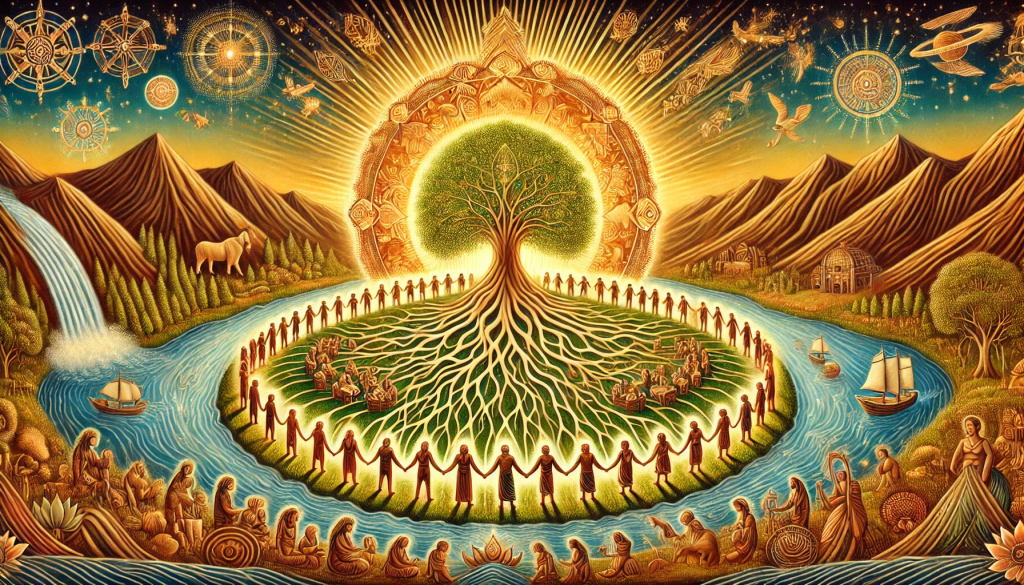
The word lokasangraha (Sanskrit: लोकसंग्रह) carries profound meaning. Derived from Sanskrit, it combines two roots:
Loka (लोक): “Worlds” or “realms,” referring to all dimensions of existence—physical, subtle, and spiritual. In Vedic and spiritual texts, lokas describe the spheres of being, housing diverse forms of life, from humans to celestial beings.
Sangraha (संग्रह): “Bringing together,” “upholding,” or “supporting.” This term suggests sustaining harmony and maintaining balance.
Together, lokasangraha translates to “the welfare of the world” or “the maintenance of cosmic order.” It reflects a commitment to collective good—working selflessly for the harmony and well-being of all beings across all realms of existence.
The Teaching of Lokasangraha
In the Bhagavad Gita, Lord Krishna introduces the concept of lokasangraha as a call to action. He urges those with higher awareness to act selflessly—not from ego, but out of compassion and duty to uplift others. This teaching emphasizes that wisdom is not a personal possession to be hoarded; it is a light to guide others, a responsibility to inspire harmony.
Lord Krishna’s words remind us that our actions are not isolated. They ripple outward, influencing the people, places, things, and events around us. Through the virtues of integrity, compassion, and commitment, we contribute to the maintenance of the balance of the cosmos through our influence on the greater good.
This teaching feels timeless, but how do we translate it into modern life? What does lokasangraha look like in action today?
Lokasangraha in Everyday Life
Let’s take this abstraction and apply it practically. At its core, lokasangraha invites us to act in service of others and the world as a whole. Here are a few everyday examples of how this unifying principle can become manifest:
• Selfless Actions: Volunteering at a local food bank or mentoring someone in need is an act of lokasangraha. It’s about lifting others, creating ripples of kindness that spread far beyond the immediate moment, and not expecting anything in return. Small acts of self-sacrifice make big impacts in the world.
• Environmental Stewardship: Making eco-conscious choices—like being the one to choose to pick up that candy wrapper in the grass, or choosing to purchase products that are supportive of the environment—reflects lokasangraha by upholding harmony in the natural world.
• Mindful Leadership: In a workplace, a leader practicing lokasangraha might prioritize their team’s well-being, treating everybody of equal value, no matter their role, and fostering collaboration and fairness rather than competition.
• Everyday Compassion: Offering a kind word, listening without judgment, or helping a neighbor can all be small, yet powerful acts of sustaining harmony. Service is the path of Karma Yoga, connection with unity through action.
These actions remind us that lokasangraha isn’t reserved for saints or sages. It’s a principle anyone can embody, in both grand gestures and quiet moments of care.
A Personal Reflection
When I first encountered the word lokasangraha, it struck a chord deep within me. I was reminded of the Bodhisattvas of Buddhist philosophy—those compassionate beings who vow to delay their own liberation to help others transcend suffering.
This idea resonates with my spiritual journey. To “free all sentient beings from suffering” is a lofty goal, but even helping one person suffer less feels like a miracle. A single kind act, like a drop in a lake, creates ripples that extend outward.
Yet, I’ve wrestled with one question: Does liberation mean escaping this existence entirely?
The Bodhisattvas aspire to free all beings from the cycles of reincarnation, believing life itself is bound to suffering. But I’ve often wondered—can’t we find liberation within this reality? Amid the suffering, there is beauty: the warmth of sunlight, the taste of food shared with loved ones, the awe of a star-filled sky. Perhaps suffering and joy are two sides of the same coin, each deepening the experience of the other.
When I reflect on lokasangraha, I see an alternative vision. In this history of humanity, we have swung on the arc of suffering. However, as we push forward into the future, our investments in technology have, and can continue to provide us with a world where suffering becomes reduced. Only with time, are we moving on the axiom of suffering and joy, perhaps so that we as a species can come to truly appreciate what it means to live in harmony.
I envision a world where, instead of liberation as escape, it can mean transforming this world into a better place—a reality where suffering is diminished, and life becomes something to celebrate. A world where all are truly equal, where society operates on heterarchal systems rather than the hierarchal ones that have deprived so many of access to power and resources.
A Shift in Perspective
This idea shifted how I view my own purpose. Liberation doesn’t have to mean guiding others out of existence—it can mean guiding others toward a more harmonious way of living within it.
Imagine this: your light is like a candle in a dark room, small but enough to banish shadows. Or perhaps it’s like a disco ball, scattering dazzling light that brings joy to the dance of life. This is how I now see lokasangraha. It is not about rejecting existence but refining it, aligning it with harmony, joy, and unity.
Through our actions, practices (sadhana), and service to the world, we each play a role in this cosmic dance. Life, after all, is a divine drama—a Lila—where suffering can be transformed into joy, ignorance into wisdom, and separation into unity.
The Divine Drama
Each of us is a microcosm of the universe. Through our practices (sadhana), actions, and service to the world, we can align ourselves with the greater harmony of existence. Life is a divine drama—a Lila—where suffering can be transformed into joy, ignorance into wisdom, and separation into unity.
This work, the pursuit of collective bliss, is the highest dharma. By committing to lokasangraha, we uplift ourselves and others, creating a reality in alignment with the infinite.
Weaving Lokasangraha into Your Journey
How can you integrate lokasangraha into your life? Here are a few reflective questions to consider:
• What lights your candle? What practices or actions make you feel aligned with harmony and purpose?
• Where can you make ripples? Are there areas in your life—family, community, or work—where small acts of kindness could have a lasting impact?
• How do you balance self-care with service? Remember, you can only uplift others if your own flame burns steadily.
Lokasangraha is not an abstract ideal—it is a call to action. Whether in small, everyday moments or large, transformative acts, we each have the power to contribute to the welfare of the world.
Final Thoughts
In a world that often feels divided, the principle of lokasangraha reminds us of our interconnectedness. Every action matters. Every intention shapes the world around us.
So, I leave you with this: How will you embody lokasangraha in your own life? What light will you shine to guide others—and yourself—toward harmony?
 Yogi Chand Tagdeep
Leave a comment